RSS Feed

Category Archives: Sermons

The gospel according to Nike

In the these two weeks, I will have gone all over the state of Arizona, on the never-ending Begging Tour of 2013 (theme: “Don’t let college students be homeless!”)
Sunday, I was in Prescott, where I’ve been before, many times. St Luke’s is a lovely parish, gorgeous campus, right by the airport. This prompted my board president to offer to buzz the church in his plane, and drop brochures from 5,000 feet. (“It would be different!”)

Here’s what I said.

Note: some of this was partially inspired by what Nouwen wrote on the use of power, but I went in a different direction, and spun it very differently– at least differently from the way I’ve heard Nouwen’s on Christian Leadership interpreted.

Rev. Megan L. Castellan
February 17, 2013
Lent 1, Year C
Luke 4:1-13

Nike is very good at marketing. These ads that Nike makes, they are iconic. Usually a close up on the athete’s face with their voice playing in the background, talking about their triumph over adversity, and their achievement of some great sports goal. And it works because Nike is good at picking the best athletes of their day: people like Michael Jordan, Magic Johnson, Larry Bird, Mark McGuire. We get to watch these ads and think about how perfect and magical these people are, and thus, how probably Nike products helped make them that way, so we should probably buy Nike things. These are really effective ads.

Or they are, right up until the athlete in question gets caught doing something that they shouldn’t, and the ad becomes really uncomfortable to watch. Like Lance Armstrong–whose Nike ad had him talking about how the only ‘thing’ he was on was his bike! And lots of hard work! And that’s why he was the best! Til of course, it turned out that he was on a heck of a lot more than that.

Or, this week, when Oscar Pistorius, the South African runner, who was arrested for murder after shooting his girlfriend. His Nike VoiceOver included him saying “I’m a bullet in a loaded gun.” Whoops.

The thing that make these ads so powerful is the same thing that makes them so problematic–each of them constructs a single arc out of the superstar athlete’s life. They struggle, they overcome, they win, and all through lots of determination and will (and really super-expensive running shoes), but it’s all them. It’s all Lance Armstrong, and it’s all Michael Jordan, or it’s all Tiger Woods. There’s no mention of anyone else coaching, or any teammates, or a random caddy. It’s all about them.

What an extraordinary amount of power for one person to have.

No wonder they keep falling short of what we expect them to be.

Power is a difficult thing for us humans to deal with– those of us who have a little and those of us who have a lot. And all of us have some power. You get up in the morning, you decide to get out of bed– that’s power. You decide what to eat for breakfast, or not to eat breakfast at all– power again. Anytime you make a decision, you’re exercising some amount of power. Now, sometimes, the spectrum of the decision is wider than at other times; when I leave here this afternoon, and I decide where to eat lunch, I will decide between local restaurants, and not decide to fly to California. My power does not extend that far. But for some, it does.

And power is complicated, because these decisions we make come with consequences. They ripple out, Iike throwing a rock into a pond, in ways big and small. So the power we wield is never just affecting us; it always affects the people around us too.

And that’s what makes power difficult and oh so tempting. You can use the power you have to just make your life easier, better, less complicated. If you’re a world-famous cyclist, yes, you can take performance enhancing drugs and win all the races, and avoid the shame of losing. But that decision, each decision will affect more people than just yourself, all the coaches, the other competitors, the people who looked up to you, the charities. When Lance Armstrong fell, it nearly killed his cancer charity too. And see, we forget all that, when we get tempted by the dark side of power. All we see are the benefits to ourselves.

That’s what the devil is on about when he’s tempting Jesus in the wilderness. The devil shows up as Jesus is fasting out in the desert for 40 days and 40 nights, which is biblespeak for “he was out there a good long while”. So poor Jesus is in quite a state by the time the devil shows up.

In succession, the devil gives Jesus three very tempting opportunities to use his considerable power. First, he asks him to magic up some food for himself. Failing that, he wants Jesus to worship the devil and thus get all the glory and authority over all the nations for himself. When that doesn’t work, he suggests that Jesus throw himself off of the pinnacle of the temple in Jerusalem, and make God send his angels to catch him.

Jesus doesn’t give in to any of these. But what’s notable about these temptations of the devil is that they’re all about the use of power. They’re all about choice.

Jesus will do miracles multiplying bread– this is something he has no objection to doing, but he won’t do it here, even though he’s hungry, because it’s for himself alone. It’s using his power to fulfill his own needs alone.

He’s clearly fine with crowds listening to him preach and coming to him for healing and waving palms for him, that’s something we see from him later on– but again, he won’t accept glory and honor here, because it would be for himself alone.

And we will even see him walk on water later, rather than climb into the boat with the disciples. But here, he doesn’t elect to jump off the temple, because it would be choosing to use who he was, all his power, for its own sake.

In each case, when the devil asks Jesus to make a choice to use the power he has for himself, Jesus says no. Jesus chooses to use his power differently, radically differently. He could have, but he didn’t.

At every point in his life, Jesus chose to use his power not for himself, but he chose to use his power for others. And in fact, right after he leaves the wilderness, Jesus heads to Nazareth and announces just how he intends to lead his life. “The Lord has anointed me to bring good news to the poor, sight to the blind, release to the captives, to declare the day of the Lord’s favor.”

For the rest of his life, Jesus would use all the power he had only, ONLY, in the service of others, and not for his own needs alone.

And so God calls us. Because we all have power too. And we are all called to use it– did you notice that at no point during that Scriptural shouting match in the desert did Jesus just say to Satan “well, I just can’t do that.” We all have power, to some degree. The question is, how will we use it?

What choices will we make? Will we make choices guided primarily by our own needs, by what serves us best, unconcerned about what the consequences are for others? But from the Garden of Eden on, making choices based on selfishness has never ended well.

Or will we follow Jesus’s example, and use our power to serve others, and build them up? Will we be mindful of how the choice we make today ripples out and affects those who surround us and those who come after us?

God has enabled each one of us with gifts and talents and then God has empowered us with the power to choose. We can choose what we do with what we have been so freely given.
Will we be tempted to live for ourselves alone, even when we know the destruction that ultimately causes?

Or will we follow in the path of Jesus, and try to use what we have, every choice we make, to the glory of God and for the good of God’s creation?

This power is ours. The choice is ours. God gives it to us. The only question is, what will we do with it?

Amen.
Day of the Dirt!

Fine, visual learners/people who read! Behold your cries and comments have come unto me.
Also I have an hour to kill before the next Ash Wednesday service, and there is not much to do in Show Low. (Motto: “Yes, that is our real name, why do you ask?”)

Here is my homily for today.
More to come on Adventure in Show Low.

Rev. Megan L Castellan
February 13, 2013
Ash Wednesday
Matthew 6:1-6,16-21

In my first call, part of my job was to be the chaplain to the preschool that was affiliated with our church. This was, by and large, a fun job. I told bible stories in weekly chapel, I led prayers at the Christmas concert and at ‘graduation’ and, generally speaking, the 3-4 year olds were theologically satisfied so long as I waved my hands around a lot, had good props, and was available for hugs when needed.
Until Ash Wednesday.
Ash Wednesday was tricky.
It’s one thing to talk to full grown adults about the need for humility,and repentance, and to mark ashes on their foreheads. I’m even okay now with being told that I myself am dust, and to dust I will one day return.
But a four year old? How do you connect a the shining face of a child to repentance and mortality? I couldn’t quite get my arms around it.

So when I gave the children the ashes, I explained that this was a complicated day, but mainly this was a day about dirt. The stuff that we’re all made of, large or small, rich or poor, boy or girl, white or black, no matter who you are. This is the day that we remember the basic truth–we’re all made of the same stuff. And it is dirt.

They liked that. Toddlers love nothing more than an excuse to get dirty.

But the more I thought about it, the more it grew on me.

Today is about dirt. Ash Wednesday is about recalling dust– the down and dirty basics.
This is about coming back to the essential, rock bottom, core truths about ourselves, about God, and taking a good long look at them. Those things that remain, when everything ephemeral passes away.

Our lives, our relationship with our creator. Our relationships with those around us, and with the rest of the creation that God has made.

Ash Wednesday is when we kneel and consider the stark ground of our being. The dust, if you will. upon which every other part of our lives as Christians is based.

And so, doing this, there are two things that stand out to me.

First of all: we are but dust. We humans are but dust. And the reality of our fallen ness, our dirtiness is evident around us. Lest we get too excited or too proud of ourselves,all we have to do is look around, listen to the news, and we are confronted again with our propensity to fail. Our willingness to fall short. Our fallible, frail nature, and the inescable fact that we are mortal. We are dust. And at some point, each of us messes up, and ultimately, each of us returns to dust.

And second:: we are but dust. Miraculously, God has made us out of Dust! And God looked at us, little dirt creatures that we are, and declared us good. Not just tolerable, but so good that God decided that the Creator of the stars of night wanted to become a little dirt creature himself.

We are but dust. we are beloved down to our dust. We are forgiven down to our dust. And we are created, and redeemed, and sustained by that divine love and grace, though we are but dust.

May that basic knowledge, as basic and as fundamental as the ground beneath our feet, may that certainty sustain us through these next 40 days of Lent, and empower us to serve the world God came to save.

Amen.

The trials of transfiguration

I have actually been preaching these last few weeks. I haven’t been posting the sermons on the blog, because I have doubted the amount of sermons that folks actually read.
Sermons are oral/aural events more than anything else. (At least, this is what I keep telling myself as I wave my hands all around and hope I don’t look like I’m suffering a spasm.)

This month, I’m on the Great Preaching Tour of 2013 to talk about Canterbury’s fundraising drive to buy a home. The students accompany me, and my trusty board president, who enjoys asking people to give money. (Fellow clergy, I am working out the cloning technology for him. Stay tuned.)
We started out in Sedona, and last week took us to Tucson. Where I got snowed in. In Arizona, this is a thing that happens when you live atop a mountain. It may be pleasantly warm in the low desert, but it is dumping snow higher up, and the roads are closed anyway.

Despite my weather difficulties, the sermon and the fundraising went very well. People who like young people are, in fact, my favorite sort of people in the world.

Here is what I said.

Luke 9:28-43

Westboro Baptist Church has become a cautionary tale nowadays–a hissing and a byword among nations. If you want to give an example of the worst hypocrisy, the worst example of hatred masquerading as religious piety, then that teeny church out in Kansas is it. After all, the members of that church spend their time not praying, or worshipping, or serving the poor, but going from event to event, protesting. They show up at military funerals, at any well-publicized funeral really, and hold signs, and loudly insist that this is God’s angry wrath punishing America for being so very, very sinful. That is their job–that’s what Westboro Baptist does. Most irritatingly and disturbingly, and unfortunately, effectively.

So it was shocking this week to read that the granddaughter of the pastor, Megan Phelps-Roper, had up and left the church, moved to New York City, and was now re-thinking the theology she was raised with. In the interview, she said she still believed in God, she still went to church (a liberal Presbyterian one in Brooklyn) but everything felt different–life had started over.

Her process of leaving had started in an email interview conducted with an Israeli journalist, who pushed her a bit on this hateful God she was describing, who killed children as punishment, and sent everyone to hell. “What would Jesus say about that? Wasn’t Jesus the person who said not to cast stones?” He asked. The question stuck in her brain, and that started the snowball rolling::-she couldn’t bring herself to hold the angry signs anymore, couldn’t yell at people at the protests, and a few months later, she left.

One little push, one little nudge, and suddenly, this young woman was beginning to transform. She was beginning the slow, awkward process of meeting God, and becoming the person that God had intended all along.

For most of us, this transfiguration process, this process of growing into the fullness of who God has made us to be, is a life-long endeavor. We stumble through it in fits and starts, we do great for a while, then plateau for a couple decades or so. It’s a process. It’s a journey, for us– the more we grow into our createdness, the more clearly we can hear God’s call to us. And on and on it goes. Grow a bit, hear God a bit more clearly.

Jesus, though. Jesus skips all that stuff. (As is typical, for he is Jesus.)
With Jesus, he’s been on somewhat of a roll this last chapter or so of Luke. He’s been going around Galilee, he’s healed, he’s taught, he’s preached. He’s tried to convey at least some of his message to his disciples, with varying degrees of success.

And most recently, Peter has acclaimed him as the Christ, the Son of God–so some of this is sinking in. Now, Jesus knows what’s going to happen next– the direct result of being the Son of God, and the Messiah is death, and resurrection, but not before the death part.
So Jesus is about to embark on the hardest, the very hardest part of his earthly ministry.
And up the mountain he goes.
He takes Peter, James and John with him, and treks up the mountain, and once there, he experiences sort of the culmination of his earthly ministry. The confirmation of who he is, and what he is supposed to do on this earth.
Moses and Elijah appear–the embodiment of the Jewish law–Moses, and all the Prophets–Elijah. And these two luminaries speak to Jesus, because if you’re the Messiah, what are you but the culmination of the Law and the Prophets? This is some great validation right here.
Then the capper– from heaven, God’s voice appearing, and thundering from the clouds— this is my Son, the Beloved. Listen to him.

This is my Child, the Beloved.

It’s a risky thing to crawl inside the mind of Jesus Christ, but my guess would be that for anyone, Jesus included, hearing those words directed at you! from the Creator would be a powerfully life-affirming thing. Something you would strain your whole life to hear, like a plant growing up towards the sun. Irrefutable confirmation that you are whole, valued, valuable, worthy and known. Down to your bones.
This is powerful stuff. The strength of this experience would give Jesus strength to “turn his face towards Jerusalem” and face the remainder of his ministry on earth. As a beloved child of God, what more reassurance did he need?

Us, well, …we live in a world that’s largely without booming voices from heaven. For us, our journeys towards figuring out who God created us to do and be doesn’t end in flashes of illumination and thundering voices. Our journeys toward transfiguration are lifelong. They double back on themselves, they twist and turn. We figure something out just to get confused all over again. A lot of the time, we don’t know if we’re headed in the right direction.

We stumble towards God, as God calls us, and we stumble towards self-knowledge, but so frequently, as with Jesus, those two things are intertwined. When Jesus figured out who he was, and what he was supposed to do, God became a lot easier to hear. And the more we grow into the truth and beauty of who God made us to be, the easier it becomes to hear God’s affirming words of love for us, and for the world around us.

A lot of the time, we have to rely on those around us, those who play the roles of Peter, James and John in our lives, to help us navigate. To tell us when we’re headed up the mountain, and when we’re headed down. To reflect back to us the shining light of God’s love.

In my work as a college chaplain– this is one of my main jobs: to form communities of disciples who can support each other and reflect to each other the light of Christ. Because when do you need more a trsnsfiguring, supportive community than those first years of young adulthood?

But though our paths may take longer to get there, they still have the same result as Jesus’s did. For each of us, even though the journey is confusing and the loving voice is hard to hear, the path of our spiritual life arcs towards a mountaintop where we arrive fully as God made us, entirely human, and completely reflecting the shining image of God. A place where God greets our arrival with joy, and we can hear the words God has been saying this whole time: You are my beloved Child– with you I am well-pleased.

Fly, Geeky Angel! Fly!

Before I totally depress us all with another installment in the Sweet-Jesus-what-is-happening-in-the-church? Series, want to hear what happened on Sunday? Because it was not at all depressing.

Sunday, as I’m sure you are aware, was Trinity Sunday. Feast day not only of orthodox Nicene faith, but of curates, seminarians and seminarian wannabes. The day when rectors and bishops beat the bushes to find the lowest preacher on the totem pole and force them to explain, in 10 minutes or less, the inscrutable mystery of the One, Holy and undivided Trinity.*

Bottom line is that I’ve preached on Trinity Sunday since I was 20 years old. I’ve developed a weird affection for it.

This Sunday happened to be my first in a steady supply gig at St. Andrew’s, Sedona. Their rector is on sabbatical, so they have me for the next three months, interrupted only by the one Sunday I’ll be at General Convention. I really like this congregation. They’re very friendly, and (being in Sedona) slightly quirky.
Best of all, their friendliness is the engaged, welcoming kind, which is invaluable. They walk me to coffee hour after each service (not just me, mind you– each visitor gets this treatment). They broke into applause after my sermon at the 10am service. (See? Quirky. There can be no other explanation for why sane people would applaud an explanation of the Trinity.)

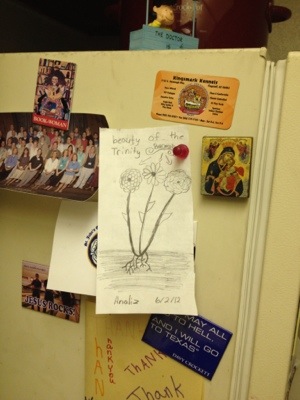
However, the best part’, the part that cemented my love for this feast, forever and ever, Amen,

was a little girl who walked up to me after the service, and handed me this:

20120604-185159.jpg

She drew it during the sermon.

I can retire now.

Anyway, here’s what I said.

Trinity Sunday! Year B

Isaiah 6
My father manages a flexible packaging plant outside Philadelphia.  He has for 17 years now. And he likes that job fine. They make that shiny film that makes it so you can see stop signs at night.  Very specific job.
But this is not really what he likes to do.  What he likes to do is on the weekends, when he coaches a basketball rec league for kids.  And every year, he does the same thing– he constructs a team of the kids that no one else picks out of the draft, kids who have never played before, or who just have no talent, or who, like me, are massively uncoordinated,  and he takes the parent who wants to help, but has no idea how to dribble, and he teaches them basketball.  Every year.

Now, my father was a professional basketball player.  He played in college, was drafted by the Celtics, played in Europe for a few years, then got hurt and retired.  He’s actually good at basketball.  And my mother, my brother and I tease him, that there are simpler ways to coach than to put on your own underdog Disney movie each year, with kids who get so excited when they get the ball that they just start running up the court holding it, and then get called for travelling. And for whom winning one game is a massive and unexpected triumph.

But Dad, i think, gets sort of offended by the teasing.  He doesn’t see the point.  To him, the point is simple.  Kids should learn the game.  So everyone should play. And everyone should get better. Everything else: winning, losing, egos, all come second.

And while most often, that ends up looking, to the casual observer, like complete chaos on the court, like little kids freezing the minute they get the ball, or panicking and outright tackling the other kid who has the ball, or something else that should really end up on a blooper reel, by the end of the year–the kids have grown.  They’ve learned.  They’ve gotten better, and they’ve gained confidence. They may never be perfect, but that was never the point.

Perfection, though, is a human obsession.  We really like to be perfect.  We like to do things right, to have things proper, in their places.  Otherwise, what’s the point of doing them at all?  Perfectionism! Very human obsession.

Watch Isaiah, in that first reading. He is having a vision of the glory of God, called before the throne of the Most High, angels flying all around– not just the normal angels, but the weirder, seraphim with the many wings, and the funky looking things, and all that.  And there are beasts and fire, and all sorts of stuff.  Overwhelming!

And in the middle of it, this overwhelming scene, Isaiah freaks out.  He remembers that he’s a bit of a screwup, and panics.  He gets the ball, and freezes like a six-year old.  “Have mercy on me, for I am a man of unclean lips, and i come from a people of unclean lips.”. In other words, I don’t always speak rightly. I don’t always manage to tell the truth, either about myself, about others, or about God.  And neither do my people.

I’m not perfect.  Says Isaiah.

And God calls him anyway.

Because that is both exactly the point, and entirely beside the point, all at the same time.
God is, in fact, well aware that Isaiah is a screw up.  God is, in fact, well aware that the people of Israel haven’t been getting it right, and aren’t going to get it perfect now, and most likely, aren’t going to get it perfect the next time either.  God’s been with them for a while now, through the exodus, the ten commandments, the golden calf mess– none of this is really news to God.  God is well aware of the tendency of humanity to consistently take a good idea and charge in the wrong direction with it.

But the reason God tries, time and again, to get it right with us isn’t because we are so very perfect and good– it’s because that’s just how God operates.  That’s who God is.

God must be in relationship. God must love.  God, by his very nature, so overflows with love that it must go somewhere, out into the universe, and so God creates a cosmos with which to be in relationship.  God creates out of love, because love is inherently creative.

The nature of God is love, and so the nature of God is relationship, is community.

God sends Isaiah and the prophets, and keeps trying with humanity, and eventually shows up in Christ, not because we’re going to get it perfect anytime soon.  But because it is in the nature of God to seek relationship with us.  To love us.  To try to teach us how to get better, and to walk with us.

You don’t teach something you don’t love.  You don’t teach someone you don’t love either.  And you also don’t teach someone who has everything figured out already.  They don’t need you.  But creation, wrapped up as it is in the embrace of God, is still being created.  The kinks are still being worked out.  We’re still being shaped and guided and taught by a loving God.  We still have a ways to go before this project is anywhere near finished.

Today is Trinity Sunday– a day when we attempt to explain one more time what on earth we’re talking about when we talk about God as a Trinity– the three in one.  One of the oldest images of this was called perichoresis.  Not only will that word win you Scrabble,but it describes an image of the Father, Son and Holy Spirit all dancing, around and around in a circle, twirling forever in a dance of creative love.

We too, are caught up in that endless dance.  We, too, are caught up in that whirl of life giving love.  Not because we have it figured out, and never is that more clear than Trinity Sunday, and not because we are perfect.  We are called to be none of those things. What we are called to be is faithful.  To keep learning.  And to keep dancing.
Amen.

*And then they sit off, afar, giggling madly and drinking adult beverages. Or at least that’s what I plan to do someday.

Once More, With Fire

So I’ve slacked off with the sermon posting of late.

This isn’t because I haven’t been preaching; it’s because I’ve been busy writing about other things, finding a house for Canterbury.etc.  Also, I am unwilling to inflict ALL SERMONS!ALL THE TIME! on you, because even to me, who loves sermons!  That seems like a lot.

But last Sunday was Pentecost, which found me at St. Luke’s, in Prescott.  Like last year, when I was spending Pentecost on the edge of the Wallow fire, this year Prescott was on the edge of the Gladiator fire which burned up the community of Crown King.  (That whole ‘fire and wind’ metaphor is sort of agonizing in Northern Arizona, let me tell you.)

Here’s what I said:

Pentecost, Year B

Acts 2


I have a thought exercise for you:  right now, as you’re sitting there, think of all the words we use to describe the Holy Spirit.  All the different metaphors you can think of that you’ve heard of for the Spirit.

Go on, I’ll give you a minute.

For some of you long-time Episcopalians, this might be a trick, since we’re not what you might call a charismatic denomination.  But we do talk about the Spirit a fair amount, even so,  even if we don’t dance in the aisles, or speak in unheard of languages, or  manage to clap in time.

So what you come up with?  Show of hands.  How many got wind?  Which we definitely know something about in this part of the world. How many got fire?  How about dove?

The Holy Spirit is that one aspect of the Trinity that we seem to love giving different names to.  Even starting in Scripture– no one can seem to refrain from going off in lots of different directions when describing this thing.  There’s the spirit that descends like a dove at Jesus’s baptism.  There’s the spirit that moves like a breath over the waters at creation.

And in the gospel, that word that Jesus uses about the Spirit , “the Paraclete” in Greek is all sorts of complicated.    Sometimes translated the Advocate, sometimes translated Comforter, it has legal connotations– like a lawyer in a court who comes to your defense, and argues for you.  In a good way, not a slimy, ambulance chaser sue you into next week sort of way.

All of these images, all of these pictures we have of the Spirit’s moving in the world– what are we to make of them?  This Pentecost, we remember the Holy spirit coming into disciples and forming them into the church, how do we follow in their footsteps and seek this elusive Spirit?

Frequently it seems that when we talk of the Spirit in church, we talk about the dove.  Or that gentle breeze that comes on lazy summer days.  We talk in terms of the Comforter.  Calm,  Happy,  Peaceful, steady things.  That old revival hymn– (sung) there’s a sweet sweet spirit in this place/ and I know that it’s the spirit of the Lord.

Good old hymn, nice picture…but is it a complete picture of the Holy Spirit?

Sure, the Holy Spirit is a dove, in the gospels,  descending on Jesus at his baptism, but as that dove descends, the sky is torn apart.  And a voice declares Jesus’ identity in a big scary booming voice, and his ministry begins.

And in John’s gospel today, when Jesus speaks of that mysterious Paraclete— he says that he will come and not leave us comfortless– that’s the part that the lectionary skips!  And testify on our behalf, which also sounds good.

But then there’s this part about how Jesus has still much to say, but cannot say it, because the disciples cannot bear it now.  So the Spirit will come and lead them and us into it, bit by bit,  this new and ongoing revelation of truth.  That sounds less warm and cozy by the second.

The spirit, when we see it in the Scriptures, isn’t just cozy, and it isn’t just safe. It doesn’t protect us from change and distress, and things that might annoy us–   It comforts, in the truest sense of the word.

It gives strength.  It fortifies.  The spirit empowers for ministry.

And that’s not always a calm, or peaceful or particularly orderly experience.  The Spirit in Acts comes like a blowing gust of wind, descending like tongues of fire.  The disciples all of a sudden seemed like drunk people, all talking funny, in languages they didn’t understand themselves. One minute, quietly in a room together, the next, spouting off in Mesopotamian.

On the one hand, speaking a lot of different languages is a neat superpower to develop.  On the other hand, it invited accusations of being drunk at 9am in the morning, and missionary activity to the ends of the earth.  Because now, all the earth, all of those people were included in the embrace of the baby church.  The fall of the Tower of Babel gets undone in the blowing wind of the Spirit.  The disciples get a power, and they get it for a purpose.  They get comforted, and sent, by the Spirit.

There are times we get lulled into wanting the Spirit just for the peaceful part.   We want that pretty white dove, and not the wind and the fire that comes with it.  Living in Northern Arizona, this is entirely understandable on a literal level, but that’s not how the Spirit operates.

The Spirit doesn’t lull us into passivity. It doesn’t take away all our problems–it helps us through them.  It moves us to service.  It stirs us, even when we are tired, and sure that we’ve done all we can do.  It shows us a new path forward, when we’re sure that we’re caught in between the hardest rock, and the toughest hard place you can imagine.


It is our breath, as the body of Christ.  When we were dead and raised again in baptism, we were sealed with the Spirit, we were empowered and called to serve the world in Christ’s name.  Like those dried bones in Ezekiel (which we heard about/was also one of the readings today) we are pulled together by God, and enlivened by the Spirit’s breath.

So yes, at times, the Spirit may be unsettling, and yes, it may be startling. The spirit may, at times, take us by surprise, and point us into places, and challenges that look crazy at first glance.  But that’s part of the journey, part of this relationship with a triune God that gives us not just “solace, but strength, not just pardon, but renewal.”


And if we want to be faithful to that early, frightened, exuberant church so many years ago, then we have to be ready of all of it.


Amen.