RSS Feed

Category Archives: Sermons

“It’s about rocks, Josh.”

This week marks the beginning of school at NAU, so my students have returned.  Hooray!  I can tell this is the case, because they have been dropping by my office, tagging me on Twitter and Facebook, and convincing me to hike with them into the depths of lava caves (a perk of living on top of an active volcano.)

And because I am gifted with particularly hardy and brave students, two of them even accompanied me to Sedona on Sunday for Canterbury Sunday at the Episcopal church in Sedona.  (It is possible they were promised coffee–we did leave at 6:30am, after all.) When I go to these churches, explaining about college ministry, and its importance, and how the church needs to welcome and uphold people of all ages, it helps to point to actual young people and say, “Look!  19 year olds who can recite Eucharistic Prayer C from memory!  Don’t you want to give them power/money/an all access-pass to the annals of the church?”  Otherwise I have the sneaking suspicion that sometimes people don’t fully believe me when I describe my experiences working with Gen X/Millennials.  Despite being one myself.

Anyway, the day went extremely well.  Aside from my students, who are awesome, the president of my board is from that church, and one of his strengths is asking for financial support.  Oh, that I could clone him.  All in all, not a shabby way to spend the 28th anniversary of my baptism.  🙂

And here’s what I said in the sermon.

August 28, 2011

Ordinary Time, Proper 17

Romans 12: 9-21,

Matthew 16:21-28

Today is the forty-eighth anniversary of the March on Washington, and the Rev. Dr. Martin Luther King Jr.’s I Have a Dream speech. And today, in DC, they were going to dedicate a new memorial to Rev. King—a giant statue memorializing his work and his life right on the National Mall, by the Tidal Basin. Then, a giant hurricane named Irene decided to strike the East Coast, because after an earthquake, a super-sized hurricane is just what they needed.

The memorial is a thirty-foot tall statue of the man, standing forward, carved out of granite, flanked behind the forward statue on either side by towering mounds of rock. The design is inspired by a line in the speech— From the mountain of despair, we will carve a stone of hope. So you walk forward into the monument through the towering walls of stone, etched with quotes from his sermons and writings, until you come up to the pillar of Dr. King, hewn from the same stone. Pretty awesome.It’s the first memorial on the mall for a non-president. And the first of an African-American.

But the monument is creating all sorts of controversy. Listening to the NPR story on this the other day, callers were complaining—he looks so angry! Why is he so big! Why are his arms crossed? Why isn’t he smiling? Why does he look so upset? He looks like an African strongman! Said one guy (that one probably takes the ‘bet you wish you had chosen a different phrase to say into a microphone, huh?’ prize).

I found it intriguing: here was a man who was unrelenting in his pursuit of justice and dignity for his people. He pursued it despite insults, threats to his mental, spiritual, and physical safety and an entire system of laws built around his subjugation. He was attacked by dogs, hit with sticks, bottles, rocks and fists, sent bomb threats, arrested repeatedly, stabbed, and finally shot and killed.

That sort of a life? That’s not a smiley life. You’ve got to have your brow furrowed to walk straight on into a firehose shooting at you. And yet, in popular imagination, Dr. King is so associated with love—love of neighbor, love of everyone, and we associate love with mildness and fuzziness, that the sight of the towering granite figure really confuses us. Because we think love should be happy!

So we’re a bit with Peter, in today’s gospel. Poor Peter, who was on such a roll last week! Jesus asks the disciples who he is and Peter says, “You are the Messiah, the Christ, the Son of the Living God!” Yes, great job, Peter. He had it all together, which was so rare for him, and he’s getting a new name, and getting the keys to the kingdom, and getting the power to bind and loose, and whatnot. So good!

And just as soon as he has it all figured out, he entirely blows it. Jesus has confirmed that he’s the Christ, and now he starts to break the second part of the news—he’s going to have to die. And Peter implodes. Nope, nope, nope, not gonna happen. And just as quickly he got it right, it goes south. Get behind me, Satan.

These two stories are the same story in Matthew—together they are the high point, the turning point in Matthew’s narrative. From here on, it’s a straight shot towards Jerusalem. No stopping, no passing go—to understand who Jesus is-truly- is to understand what that implies–that he’s going to die. The two are inseparable.

When I write sermons now, I like to pretend that my younger brother is reading over my shoulder. My brother has a habit of listening to every pronouncement I make and saying “So what?” “God loves you” “So what?” “Jesus died for you” “So what?”

It’s annoying when I have writer’s block, but in terms of writing an effective sermon, it’s useful.

This is not, however, a question that Peter asks. He arrives at the first right answer—Jesus is the Christ. He never asks, “So what?”

He is so content to stay with the glory of being right, of getting the answer right, that he doesn’t move on to what this means, either for Jesus, or for himself.

Jesus is the Christ, so what should the Christ do? Jesus is the Christ, so what should Peter do?

And when Jesus answers that question, Peter doesn’t enjoy the outcome. Jesus is the Christ, and living like the Christ is called to live, is going to end up somewhere Peter doesn’t want to be. It’s going to end inexorably in death. Living like the Christ is called to live, living out this kind of all encompassing love, in this world, will end in one way. Live out that kind of love; live out the implication of Jesus is Lord, and you will be living outside of what the world expects of you.

The world, as it is now, in its brokenness is not constructed for this sort of life: the world around us asks us to strive for smaller loyalties, smaller goals. It asks us to pay attention to ourselves, first and foremost, tells us that we are all islands, complete with trusty bootstraps that can be

pulled around and up, and the loyalties we should honor are the ones that come easy– all those people who look/think/feel/talk like us.

But Paul lays it out for us in Romans like a manifesto: love what is good, hate what is evil. So far as it depends on you, live in peace with everyone. Do good to those who persecute you. If your enemy is hungry, feed them. If they are thirsty, give them something to drink. Do not be overcome with evil, but overcome evil with good.

Nothing on that list that Paul gives us is passive. Nothing on that list is weak, or small. Living in the footsteps of Christ places us, necessarily, a step or two out of sync with the world as it is. Living out the depths of the love of Jesus means that we walk a bit off pace with the rest of the world. Because, we confess Jesus as Lord, and we owe our allegiance to God, and not to nations, or tribes, or money, or any other smaller loyalty or deity.

That’s the so what. That’s what it is right there– and that’s what’s so hard for Peter. Confess Jesus as Lord, and you have to pick up your cross, cross your arms to smaller gods, and walk to a whole new rhythm from now on.

That’s the life we are called to: that’s the love we are called to, we who confess Christ. We aren’t just called to words that we recite, we are called to a way of life. And though it means daily picking up our cross, and

following, it’s only this kind of life, and this kind of love that can wear down the mountains.

Amen.

Flexible Rocks

This week was at a new (for me) church, in Holbrook.  Holbrook is located about 90 mi east of Flagstaff, on the border of Navajoland, and is home of not a whole lot.  (Holbrook, in case you ever visit, is further out on I-40 than is Winslow, of Eagles-song-fame.  All Winslow has going for it is the song, but bless their hearts, they have The Corner, with a Ford truck, and a wooden cut-out of a man standing there, and that song, playing on a loop.  You, too, can come stand there and Take It Easy!)

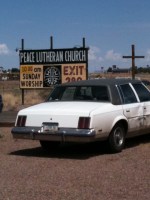
Notably, however, there are two churches there–an Episcopal one and an ELCA one.  The Lutheran one called a few weeks ago, and asked if I would come supply.  I asked for directions, and he said that I had to remember to turn at the Burger King.  Okay.

Sure enough, there was a Burger King, whereupon I should turn.  And there was a gravel road and there was the church.  I took a picture, so y’all can see.

It’s a teeny place, but the people are wonderful, and extremely kind.  And I conquered a new setting in the Cranberry Book!  (Btw, I am again amazed at how calmly everyone seems to have taken to the liturgy change in the ELCA.  No riots, no shouting, no nothing.)

Anyway, here’s what I said come sermon time.

Ordinary Time, Proper 16 Matthew 16: 13-20

The church in the town where I went to college lacked electricity. Built in the mid- 1600s, it was lit at night by wax candles, and staffed by clergy who learned quickly how talk really loudly. We had a pipe organ, but we also had a harpsichord which got not-infrequent use The joke among the college students was “How many Parishioners does it take to change a light bulb?”. “none! Heaven forbid! Why would we ever want those newfangled things in here?!”

For all the church attempted to remain faithful to its historic roots, it never quite managed it completely. And I really enjoyed leading the noonday prayer service with the visiting tourists– like a walking, talking, head on collision between 1774 and the early 21st century. Only since 1965, after all, could women read in church.

Because despite our grievous lack of light bulbs, in fact, we had changed.

The gospel story for today finds Jesus and the disciples at a crossroads, both literally, and figuratively. They’ve come to Caesara Phillippi, this city up way north, where the Jordan river starts, and Jesus says, What are people saying about me? Who do people say that I am?

Now, it’s sort of a throwaway line, in the text, isn’t it, where they are when this happens. But Caesara Philippi is an important place for the Roman Empire. It was the center of worship for a lot of different gods and goddesses and had been for generations back– think of it like a smaller, pagan Jerusalem. Tons of temples, all devoted to a different Roman god or goddess.

So when Jesus is saying this to the disciples, he’s not just randomly picking a topic out of the air– he is saying this in the midst of the idols of the glory of Rome. “you see all this? Now who do you say that I am?”. Is more the question here.

And up steps Peter. Good old, stick your foot in your mouth Peter. ” you are the messiah, the christ, the son of the living God.”he says.

Yay! You almost want to throw Peter a parade, because it’s so rare that any of the disciples stumble across a right answer or seem to really know

what’s going on much of the time, bless their hearts. But here we go, good on you Peter. Son of the living God, indeed.

It’s a blinding flash of insight, because that one phrase is so true,….and so very different from the culture that surrounds them.

Jesus is the Son of the living God, Jesus is alive, and dynamic, not fixed in stone and wood like the gods and goddesses of Caesarea Philippi. Peter’s relationship with Jesus is living and growing, and not static, and fixed forever.

Jesus is the living God.

Which is precisely why Peter is the one who understands what is going on. Because let’s think about this for a moment. In the story so far– has Peter acted like someone who is fixed, and unchanging? Has Peter been ‘a rock’? Has Peter been the steady, solid, dependable one?

This is the guy, after all, who charged off after Jesus, and abandoned his fishing business. This is the guy who saw Jesus through the storm on the Sea of Galilee and volunteered to stride across the surface of the water in a lightning storm! to meet him– a gutsy move, to be sure, but not a really practical, pragmatic one. Not something you’re going to tell your kids to do.

This is the guy, who– in the coming chapters, will chop off the ear of the high priest’s slave, and lie to save his own neck, and cry with remorse, and basically run the gauntlet from one emotional extreme to another. Not always getting it right, but definitely trying.with all he’s got.

Calm and steady, he may not quite be, but alive and engaged, Peter certainly, certainly is.

And it’s on this sort of alive rock, that Christ builds his church. Not the cold, dead stone of idols, that stands fixed and unmoving through the centuries. Not unresponsive stone that protects itself first, but living rock that lets itself be shaped and affected by the world around it.

We, as the church, have to resist the urge to harden ourselves against all winds of change. While some forces of change aren’t particularly helpful, many of them are winds of the Spirit, and when we harden ourselves to them, we risk closing ourselves to the living God.

The church is here to serve the world, to give ourselves to the people around us in self sacrificial offering and we can’t do that if we are concerned only with our own protection and our own well-being. We need

to be a little bit impulsive. A little bit rash. A bit emotional and engaged, and little bit like Peter.

Our history is wonderful; our traditions are wonderful, but we are called to follow a living God, and not them; and they can’t be our idols.

Our job is to be flexible, to be alive. Not to be trapped by the old ways but be free to meet the needs of the people we are called to serve here and now.

We don’t always get it right– who knows, but that the next generations will hang their heads and sigh in annoyance about all the things that we managed to mess up–but that’s the beauty of following a living God. God never gives up,and God never stops calling us on. So we need to keep journeying onwards. Amen.


Talking back

This week I preached at Epiphany, on one of the Top Ten Cringe-Worthy Pericopes of the Gospels. (This would make a fantastic list/review television show, don’t you think? I’d like Joel McHale to snarkily host, please, and discuss them! The Mary/Martha serving story and the Samaritan woman at the well, etc. Make it so, someone!)

While I have a grudging respect for this text, the problem with it is the same as many of the others in the Top Ten: they’re a litmus test for assumptions. If you read it, assuming that, of course, Jesus has to be right, always, and the stories are always about Jesus and His Rightness. And if you preach it from that angle, then you get to one answer. Which is fine, generally, nothing wrong with that. But this frequently leaves you with an object lesson not so much about what you, personally, should do in the world, as much as what those Other People should do in the world. (You are okay by virtue of already understanding the nature of Jesus and His Rightness, you awesome person, you!)

It is also possible, however, to more closely identify with the other characters in the story. So if you assume that the gospel stories are just as frequently about people just like us, and our reaction to Jesus and His Rightness, then you end up somewhere different. And generally, the gospel becomes a dynamic meeting place between God, and us, and our messiness.

Guess where I ended up!

Here’s what I said.

August 14, 2011
Proper 15, Year A
Matthew15:10-28

Fr. Roy Bourgeois was kicked out of his order last week. He’s a Roman Catholic priest, a Maryknoll priest, who, of late, has taken to travelling around the country speaking in favor of women’s ordination. Which was precisely his problem; according to the public statement from the Maryknoll order, they felt his public statements in favor of women’s ordination would give the mistaken impression that the entire Roman Church had turned a corner on this issue. So they kicked him out.
I met him when I was 18, interning at Sewanee, when he spoke to us about his work protesting the then-called School of the Americas.
And I sort of forgot about him, until a Phoenix taxi driver, a Hindu, discovering I was a priest, asked me if I knew of him.
“I’ve always admired his work,” he said. “He never had to take any of the risks he took.” He seemed like a man of integrity.

A man of integrity, and now his case is being referred to the Vatican, to see whether he will be permanently defrocked.

How do we know when to talk back? When do we decide when to challenge what we’re told? Especially when talking back is going to cost us something?

The gospel for today is a tricky one. Jesus and the disciples are evidently getting in trouble with the local religious leaders, mainly for suggesting that ritual purity is less important than purity of the heart.
Since the Pharisees were a group founded on the notion that the best and fastest way to achieve purity of the heart was through things like washing your hands, in accordance to the law of God, this suggestion of Jesus would not have been popular at all. It would have made them very annoyed.
So there’s a bit of a family feud happening– Jesus vs the Pharisees. And because it’s in the family, the rhetoric got really heated. Hence the blind leading the blind stuff. (it’s worth noting that most scholars now think Jesus had at least some ties to the Pharisees himself. That’s why there’s all this sniping.).

But what gets more troubling is when everyone heads away from Jewish territory, into Tyre and Sidon. Jesus has been saying that faith comes from within, and is shown through ritual and other works, which is fine and well and good, but here comes this poor Canaanite woman, and the wheels come right off the wagon.

Now, I’ve heard a couple different explanations given for what’s happening here. Some people think Jesus is acting deliberately dense to teach a lesson to his disciples on how not to behave. Sort of a weird object lesson of what he was trying to teach the Pharisees. Which I’d believe easier, if his disciples didn’t initiate the “send the foreign woman away!” campaign.
Some people think Jesus is testing her faith. Which just seems odd. Why has he started testing faith now, with pretend deafness and insults?
In any case, none of this quite disguises the fact that Jesus acts like a jerk to this woman. She comes to him, begging for help, and he first ignores her, then talks about her, then calls her a dog. You shouldn’t take the children’s food and feed it to the dogs. A much, much worse insult in the ancient near east than in our culture, and it’s not a compliment here.

But she comes right back at him. She answers right back.

And it’s her answer, it’s her mouthiness, if you will, that convinces Jesus of her faith. It’s that that convinces him to heal her daughter, and to pay attention to her. Her fight, her argument changes his mind, changes his behavior, and makes him listen. Her comeback makes him live up to what he was teaching in the first place.
It’s what’s inside that counts. Not race. Not ethnicity.

It was a big risk. Women didn’t speak to men they weren’t related to back then, generally speaking, non-Jews didn’t speak to Jews, especially not to rabbis. She’s taking a lot of risks.
But it’s taking this risk, that gets Jesus to look at her, finally, and recognize her faith.

Faith in her daughter, certainly, love of her daughter, certainly. But it goes deeper than that.

This woman shows faith in Jesus too. She doesn’t let Jesus get away with that sort of behavior. Somehow, sort of against the evidence, she expects better of him.

Because having faith in someone, in an organization, demands that we act as this woman did. Having faith in someone means we believe the best of them. It means we expect them to live up to what they proclaim, or at least that they try to. Walking the walk and everything, to the best of your ability.

it means that when they fall short, we remind them of what they are called to be. We don’t give up on them. We urge them on. We talk back. Even when it gets uncomfortable and unpopular, we talk back. We hold up the mirror of who they are, who they are meant to be, up so they don’t lose sight of it against all odds, and against all resistance.
Having faith in this country means asking it to live up to equal rights, due process, voting, all that stuff. Having faith in the church means you ask it to act like the church, as much as it can, please, even when it appears cheerfully hell-bent in the opposing direction.
Now, it’s a dangerous thing to have faith in a country, or in the church, or in anything, really. These things are human! They are filled with fallible people and you will get your heart broken, time and again.
But part of living on this planet is living in community. And so we are called to care for the communities we live in, for better or for worse.
The Canaanite woman goes unnamed in the Scriptures, but she’s the patron saint of all those who took a risk to hold the wider community
accountable to what we’ve been called to be. Short of the Second Coming, we are never going to entirely fulfill God’s vision for the perfect Church or the perfect city or the perfect state.
But thanks be to God, that we have examples of those who hold the mirror up to us, all through out history, to help us get there. And may God give us the grace to listen to their words of faith in our time. Amen.

Elijah: Ancient Israel’s Answer to Johnny Cash

Sunday was spent again at the friendly Local ELCA Parish, and this time, I made sure to get the readings correct. (Take that, lectionary curse!).
This was my second week in a row with Friendly ELCA Parish, and they were again so nice to me. We were scheduled to have a Camping Eucharist (oh, those crazy Lutherans!) but not enough people signed up at the last minute, which was a disappointment, because when I’m talking at length about wilderness, it helps to literally be in the wilderness. But oh well. Being on the side of a giant volcano crater, in a building, gives a similar effect.
Here’s what I said.

Rev. Megan L. Castellan
August 10, 2011
Proper 14
1 Kings 19:9-19

One of the biggest changes I had to get used to moving out here from the East coast was the highways. Driving down 95 in the east is a pretty social experience, even if you are by yourself. There are exits every mile, with food, gas and hotels aplenty. And when you get north of the Mason-Dixon line, there are rest stops with Starbucks in them every so often. Running low on gas or caffeine, if you have the money, isn’t really a problem.
This is not the case here, as y’all know. Driving from here to Phoenix is a long stretch of desert, broken up only by Camp Verde. Other than that, you’re out of luck. No people, no food, just wilderness as far as the eye can see (which, out of the high desert, is a pretty far ways). So I’ve gotten pretty good at checking my fuel and making sure I have water. Because we have us some honest to goodness wilderness out here.

In the Old Testament, wilderness is a constant. The Israelites wander in the wilderness for 40 years (or, in biblespeak, a really long time). Moses meets God in the burning bush in the wilderness. Hagar escapes with Ishmael and is saved in the wilderness. Abraham hears God and receives the covenant in the wilderness. Most really important things happen for the people of Israel while in the wilderness.

Which actually sort of bugs them. Because, if you read these stories, they aren’t fans of the wilderness. No one is. And here, I’m not necessarily talking about the relative merits of Starbucks vs camping, or the beach vs the desert or the mountains.

For the ancient people of Israel, the wilderness was the murky undefined place you went when you were on your way somewhere. It was an in-between place. A place of getting lost and being confused and not having a settled home, or roots. Which, for a group like the Israelites, who defined themselves in relation to the Promised Land, was a really unsettling feeling.

But. The wilderness is also always where God shows up. Always.

So today. We meet Elijah as he’s fleeing to the wilderness. Now, understand this about Elijah– it takes a lot to make him flee. He’s the greatest, most confident prophet Israel has ever had. He’s Notorious. He’s intimidating. He calls the shots. To picture him in an ancient near eastern equivalent of a black leather motorcycle jacket would not be far off.
No one messes with Elijah.

Until someone does.

Elijah’s problem begins when King Ahab marries a non-Israelite woman named Jezebel. And I know you’ve all heard of her. Or at least can guess that she was not a model of kindness and decorum.

Right away, she gets on Elijah’s bad side, because she brings her gods and her cultic practices with her. She re starts the worship of Baal in Israel– rebuilds the temples on the mountains to Baal, whole nine yards.

So Elijah, being no shrinking violet, offers her priests a challenge– whose god could call down fire from the sky to burn the offered sacrifices? It doesn’t go great–
This little bet ends with Elijah slaughtering the 450 Baal priests singlehandedly, and Jezebel offering to kill Elijah by the next sundown.

Whoops.
Realizing that perhaps he’s gone a wee bit far, Elijah flees to the wilderness. All the way to the wilderness. He flees from Mt. Carmel in the north (right by Lebanon) to the desert of Beer-Sheba in the south. In today’s terms, that’s about a 4 hour car ride on nice highways with no traffic. Or checkpoints.

Elijah is out of options. He’s convinced that his nice career as a court prophet and an Alive Person has come to an end. But more than that, God seems to have abandoned him. The god who so readily came to his aid and killed this hundreds of Idol worshipping heathens in a blaze of fire from the sky is nowhere to be found.

After all, prophets who are on the good side of God don’t have to flee the kingdom in the dead of night. That’s not how this is supposed to work.

So we meet Elijah today, in a funk. In a cave. In the wilderness. Alone and confused and depressed.

Because what has worked up til now has stopped working. He’s in a cave, towel thrown in.
When something odd happens.

God calls to him, and asks him what he’s doing there. And the whole sad story pours out– and note please, how pitiful and picked on mighty Elijah makes himself sound. It’s great. He’s having a real pity party in that cave.

And then God shows up himself.
But something’s different. Because this God isn’t in the earthquake or the mighty wind that splits the boulders, or the fire that destroys. This is a still, small silent God.

This God who appears to Elijah now is a far cry from the god who threw down fire from the sky and killed all those idol worshippers. This God appears in silence. In peace.

It’s a major attitude adjustment for Elijah. But he hears God again. He refinds his calling. And God sends him back to do what God has been calling him to do. To use his gifts in a different way,

But that’s what happens in the wilderness, in those unsettled places, unrooted places. Places of travel, of transition. You go in one way, you come out another.
Sometimes by conscious choice, and most of the time, not. But the wildernesses of our lives always offer the opportunity to stop and refocus on where we are being called. Who we being called to be. And who is doing the calling. And the voice we hear may not be the same each time we pass through. But it’s there if we listen– often in the most mundane places.

I used to work the overnight shift in a 24 hour gas station and convenience store off the PA turnpike. So around 2-3 am I would get the long haul truckers in to get coffee and snacks. They’d come in looking tired, but always would perk up when I’d hand them coffee. One guy commented to me early one morning that it was just nice to see another person, alive and awake, like he was, and talk to someone not through a radio. It made him feel less alone in the world, he said.

The times we spend in the wilderness, the times we spend uprooted, feeling confused and drifting. These can be scary times. But these are times that God uses to refresh and reorient us as we journey. God calls us to the wilderness– Christ calls us out of the boat– and with God waiting for us, what can we do but follow?

///
So if you’ve been panicking that I won’t post any more sermons on here now that the summer is ending, fear not! I seem to have been hired by another semi-local ELCA church to preach at them until they can hire a regular pastor. So the sermons, they shall continue.
Also, seriously, the Rob Bell thing is coming. For Real this time.

When the Lectionary attacks…

I’m back! Now that my second week of camp, plus a week of intensive community organizer training, (possibly more on that later) plus a week of East Coast friend seeing, has ended, I’m back in the coolness of the AZ mountains.

And fittingly, today, I preached at the Friendly Local ELCA parish. Where the RCL decided to attack me. This will make more sense if you read the sermon, but I start out by saying slightly unflattering things about the lectionary’s habit of taking scripture out of context. Evidently, there was some sort of karma attached to this, because when. I got to church this morning, I discovered that this parish wasn’t reading the Genesis reading– they were reading the alternately scheduled Isaiah one.
I had written a sermon half on an unread reading.
Curses, lectionary! Foiled again!
It turned out okay. I worked in my error and told the congregation that they were getting a special, bonus reading, “like Ginsu knives!”

And here’s what I said.

July 31, 2011
Proper 13, Year A, Ordinary Time
Genesis 32:22-31, Matthew 14:13-21

The lectionary– the schedule of what from the bible we are supposed to read every Sunday, along with most other mainline Christians– has some really good points.

It forces us to read almost all of the Bible over a three year cycle, it forces preachers to preach on stuff that most of us would rather avoid, rather than our two or three (or one) favorite topic, over and over. And it keeps us on the same track as Catholics, the orthodox, Methodists, us Episcopalians, you Lutherans, some baptists even, almost everyone! Which is nice, nowadays.

But unfortunately, occasionally the lectionary pulls something like it does this week.
(and I’m telling you right now, one of the things the lectionary pulled this week was that I prepared part of this sermon on the alternate OT reading, rather than the one we actually read. So when you hear me talking about Jacob wrestling with the angel, that’s what’s happening. Think of it as a bonus story, like Ginsu knives!)
Observe the gospel: “when Jesus heard this, he withdrew from there in a boat to a deserted place by himself. But when the crowds heard it, they followed him on foot from the town.”. Then follows the argument with the disciples about who will feed all these hungry people, and everything else, but it starts with Something Happening.
Something that the lectionary skips over.
Which is really unfortunate, because this Something is very important, because, if you have read back in ch 14, then you know that what’s just happened is the execution of John the Baptist at the hands of Herod.
Jesus hears the news, and has to go grieve in private. The crowd to whom he’s been preaching, immediately find him so that he can comfort them. And he has pity on them.

And knowing that, how different the whole story sounds now. The moments of conflict, of questioning struggle, of tension, inform everything else. They are important, and can’t be glossed over.

It’s true in the Jacob story as well.

Now, if you’ve been reading along on the Genesis track these past few weeks, then you know that despite having a rather big role to play in the relationship between God and the Israelites, Jacob was not a fine, upstanding character. He steals his older brother’s birthright, he tricks his father-in-law, he robs him as well, and occasionally, has the grace to feel slight regret about it. He’s not the person you’d necessarily want your kid to look up to, morality wise, but he survives.

When we meet him this time, he is alone, beside a river.
Again, what comes before is important. He is beside this river alone because he is preparing to reunite with his estranged brother Esau. He’s sent all his wives, children, and flocks on ahead, because he’s pretty sure his brother is going to kill him, on account of that whole stealing-the-birthright-and-leaving-him-penniless thing. So Jacob has gone ahead alone to meet him, and contain the damage.
He’s not in a happy confident place, and it’s in this context that he wrestles with the stranger.
He struggles. Despite a conviction that he will lose all he has, and despite a sort of sneaking suspicion that he might deserve that, Jacob still wrestles with God.

It’s the struggle, the tension that’s important.

The struggle is what leads him to God, it’s what leads us to God. Not skipping over it. Not wishing it away or cutting it out. That struggle, that wrestling, that is what we call faith.

Because faith isn’t figuring out the answers one day in a blinding flash of light, then never questioning them again. Faith is wrestling with God. Faith is withdrawing by yourself in a sulk so that God has to come find you. Faith is being a holy pest. Faith is a messy, messy process of asking and answering and asking over and over and over again.

And yet….often times, we try to forget that part. We try to forget about the messiness. We try to get away without having to struggle. Today, the lectionary presented these stories as context-free, sort of glossing over everything messy that was lurking underneath, behind and around them.
Jesus didn’t just wander up to a cheerful crowd and decide to feed them. This crowd was grieving the execution of their leader at the hands of a tyrant, and Jesus was moved to pity for them. So he argued with his disciples in favor of feeding them. “Don’t send them away–YOU give them something to eat.”.

Jacob didn’t just lay down for a good night’s sleep of the contented and satisfied and see God, he was guilt ridden and troubled about where he had ended up in his life. And with good reason. But his panic and his guilt cause him to grab hold of the stranger and refuse to let go until he has a blessing.

We’ve seen in these past weeks some of the very real dangers of clinging to easy answers. Clinging to hard and fast answers that never change through time or circumstance, that don’t see the image of God imprinted on each human face. that divide people into fixed categories of good and evil, worthy, and unworthy, worthy of life, and worthy of death.
The events on Norway have shown us once again how dangerous this is, because the man who killed all those people, claims to have done it for the sake of the faith we profess.

Now we who sit here know full well that only a total perversion of Christianity could even come close to allowing such violence and hatred. Mass murder has no relation, no justification in the gospel of love Jesus came to proclaim.

But it becomes ever easier to shape the gospel in our own image when we decide that true faith can involve none of the messiness of revision or diversity. When we decide that our certainty has the final word, and not the Spirit who leads us slowly into a greater truth.

Because, truly, it is the Spirit of God who wrestles with us, in our questioning, and our struggles. And though at times it seems exhausting and fruitless, it is through wrestling that Jacob receives his blessing, and it is through arguing that Jesus feeds the crowd.

Not easy certainty. Certainty doesn’t need a living God; A wrestling faith does.

Faith is messy, and exhausting, and a lot of work. But a living God, a living Spirit demands a live response from us and it never gives up.

Amen.

Oh and one more thing. I promise, PROMISE! To finish the Rob Bell series. I have finished the book, and I just need to write up the final post(s). They should be up later this week, or early next week.