RSS Feed

Category Archives: Sermons

People get ready

My parents were here for Thanksgiving.
They traveled all the way out here for a full 3 days, and got to experience most of what Kansas City has to offer.  We went to many restaurants (including Joe’s KC for BBQ).  We went to the Negro Leagues Baseball Museum, and the WWI museum.  I gave them a driving tour of the Plaza, all lit up.  And they tried in vain to figure out where Kansas was.
(“It’s across that street.”  “It can’t be!  That’s a neighborhood!” “Yes. That’s Kansas.” “In a neighborhood?!  With different license plates and everything?!” “Yes.  Because it’s Kansas.”  “But where’s the river?” etc.)

They also got to hear me preach, which doesn’t happen all that often.
Preaching (or doing anything, really) in front of one’s own family is rough.  Jesus wasn’t lying with that crack about prophets not having honor in their own hometown.  The trouble with your own hometown is that this is the town that conflates grownup, professional you with the you who once was madly in love with Beanie Babies.

Here’s what I said.

Rev. Megan L. Castellan

November 28,-29, 2015

Advent 1, Year B

Luke 22


The good news which I have for you this day, is that whatever odd little subgroup of humanity you may belong to, TLC has a reality show spotlighting you!  Yea and verily, TLC has shows about people in over-large families, people who compete in child beauty pageants, people who have multiple wives at the same time, little people, little people who then get married, people who obsess over strange things, people who have psychic experiences while living in Long Island, and people who experience regrettable tattoos, and people who are mall cops.

It’s a veritable cornucopia of the strangeness of humanity.  

And, then, there is a whole OTHER subgenre of people who are concerned that the end of the world is upon us–the preppers.  

These are a group of people who are collecting supplies to prepare for the end of society as we know it–usually canned goods, potable water, generators, ammunition, things like that.  And not surprisingly, they are not generally a cheerful bunch–mostly, they grimly await the chaos they expect.  In fact, as I was researching this, the star of the biggest prepper show was arrested and put in jail on weapons charges.  

To these folks, the end is something you have to prepare for grimly, by cutting yourself off from everyone else, and hunkering down.  Since the worst is coming, best to minimize the damage to yourself, so that you can survive.  Everyone else can just fend for themselves.

That’s one way to go, certainly.

Probably not the Christian way, however.

In the gospel. we’re again in an apocalyptic section, where Jesus is again talking to the disciples about what’s going to happen to them.  Or, to be more precise–he’s talking to the community that Luke’s gospel is written to about what is currently happening to them–lots of scary things involving Roman persecutions and the fall of the Jerusalem Temple.    And again, it sounds scary to us.

But, I would like to point out that at no point in any of his apocalyptic diatribes does Jesus recommend building a bunker.  Or stockpiling food.  Or retreating to the desert.  (That was John the Baptist, and he didn’t last long.)

Jesus, on the other hand, says that when you see all this horrible stuff happening, look up!  Lift up your head!  Get ready!  Because your salvation is coming.

Be on guard, and don’t be weighted down with worries of this life.  Because that day is coming unexpectedly.

Don’t move out to a cave, and give up on the world.  The kingdom of God is still near you.  Right now.

They must have thought he was nuts.

Where’s the kingdom of God when our temple is being destroyed?  Where’s the kingdom of God when Caesar is hauling us off to the lions?  Where is my nice cave when I need it?

The kingdom of God, though, doesn’t emerge in a cave.  Or in a bunker.  Or in a top-secret, super-safe facility in an undisclosed location.  The kingdom of God emerges in community.  Where two or three are gathered together in the name of Christ, and when we share together the love of God.  That’s what the kingdom looks like, and that, we cannot do if we choose to hide in a corner, away from the world.

The kingdom of God does not come apart from the world, with all its chaos, and its turmoil–the kingdom comes in the very middle of of all of that mess.  Unlikely as it feels.

So, our response as Christians to when the world seems about to turn upside down cannot be to beat a hasty retreat to the nearest cave.  Or to batten down the hatches in fear and ride out the storm.  We cannot let fear run our lives, and cut ourselves off from each other and from the world God made and loves.  


Our response when everyone around us cries that The End is Near! must be to dig in our heels, and take the gospel even more seriously.  We must give even more generously, do even more good, seek even more after mercy and justice.  We must remember even more deeply to be the hands and feet of Christ in the world.  We have to care for each other even more.  And maybe it is foolish, and maybe it is risky, and maybe it is even a bit dangerous–but it is in the times when the world seems the most dangerous when it most needs the kindness that Christ teaches.


It’s the beginning of Advent today, though we’re disguising the color a bit, due to another mass shooting.  But honestly, I think our red/blue mix is appropriate.  Because, contrary to what Hallmark tells us each year, Christ didn’t come into a peaceful world.  It wasn’t a settled world, with everything perfect, Mary, Joseph just hanging out lazily with some picturesque hipster shepherds.

That world was a mess, too.  It was violent–there were wars, rebellions, prejudice, and disease.  Jesus would become a refugee before his second birthday.  It’s not so different from our world.  And, in fact, believe it or not, there were quite a few sects of Jews who were all about hiding in caves and waiting for the end of the world back then.  That’s how bad it was.

But it was right in the middle of that mess that Christ came.  In the mud, in the straw, in the dirt and heartbreak.

And that is where he sends us too.  

So, be strong.  Lift up your heads.  The kingdom of God is near!  


Amen.
In Which Megan writes an extra sermon by accident

I spent the last few days at the Gathering of Interim Bodies in Baltimore, MD, and came back Saturday night.  Contrary to the way it sounds (like a symposium of plague contagion), it was a lot of fun for those of us who enjoy thinking about church canons and governance (all 3 of us).  And we got a lot done.  For example, I succeeded in getting my commission to rename itself ‘Commission for Law and Order’, and to employ the regular use of sound effects borrowed from the show.

But, the aftereffect of these several days of continuous meetings was that I had the fixed idea that I was supposed to preach on Sunday.  So I wrote a whole entire sermon on the plane ride home, only to land at KCI and realize that no, my rector was supposed to preach.  I had a #bonus sermon on my hands.   Sort of the reverse of that clergy anxiety dream–instead of showing up with no sermon, I showed up and had an extra one.

But I’m rather fond of what I wrote, so I told Twitter I would post it here.

Happy early Thanksgiving, blogworld!  I am very grateful for you.


Rev. Megan L. Castellan

November 22, 2015

Ordinary Time, Proper 29

John 18


(If my kingdom WAS from this world, my followers would fight.  But as it is, my kingdom is not of this world.)


While I was in Baltimore, this past week, I had dinner with my (very Catholic) grandmother and aunt.  Whenever we get together, it’s basically a running ecumenical dialogue, and this time was no different.  They were telling me of this trip they had taken over the summer to York cathedral in England, with my teenaged cousin.  While on the tour, guided by an apparently-quite young English docent, they saw a tapestry of St. Peter, being handed two keys, one silver, one gold, by Jesus.  

The docent remarked that she’d been asking everyone, all the clergy she knew, what on earth the keys were about, and no one could tell her.  My grandmother fixed me with the same glare she gives her parish priest when she is displeased with the sermon, “Do YOU know why Peter would have keys?”

I was pretty sure this was a test.  “Yeah—they’re the keys of the kingdoms—signifying whatever he looses on earth will stay loosed in heaven, and whatever he binds on earth, etc.”

Grandma nodded emphatically.  “Yes!  Exactly!  And Clare knew too.  BUT THIS PIPSQUEAK OF A DOCENT HAD NO IDEA.”


I consoled her by pointing out that I could make no excuses for the English educational system for clergy, but clearly it was an abject failure.  But, I don’t think they’re going back to York any time soon.  


In thinking about it since, I’ve been wondering if in fact the docent’s ignorance of the symbology of Peter’s keys is more attributable to Englishness than an educational gap.  England, after all, is a place where there is only one operational “key”—there’s one law governing both church and state, the church is established, and no separation seen between them.  So perhaps it’s not so natural to think that Christ would pass off to Peter two keys: one for heaven, another for earth.  Perhaps it’s not so natural to think that these would be separate—another Protestant innovation to the faith once handed down.


The danger seeing only the one key, however, is that it lulls you into complacency.  Since the time of Constantine, Christendom has wanted to claim that it’s kingdom is THE ONLY kingdom, that it’s realm can be the only realm exists on earth.  Any other realms, any other kingdoms must either convert, or be subsumed in our wake.  And thus, in our history, we’ve been susceptible to thinking that the way of these earthly kingdoms must be the way of the heavenly.  


I mean, there are kingdoms which claim the name of Jesus.  There are kings all over the place speaking of their prayer life.  There are kings duking it out on the news about how all good citizens were Christians….so, it can be tempting to believe that Christ’s kingdom and our earthly kingdoms are the same.  Or at least close enough for jazz, becoming a mortifying thought, as we watch the kingdoms furiously rage together as well.  


And we should be aware that there are people who have staked their entire careers on continuing that line of thought.  


But we should also be aware of this conversation between Jesus and Pilate.  


Pilate, who decides to have an existential debate with Jesus at his trial, asks Jesus who he is, where he has come from, and how is it that people call him a King?  


Jesus replies, in typical Johannine fashion, that he is a King, but a SPECIFIC KIND OF KING.


There’s a political context here which is important—Pilate is the governor of a rebellious province sent to quell dissent.  (Think Hunger Games.)  For Jesus to stand before him and claim to be a king is as rebellious as you could possibly get.  It is Katniss giving that salute in the arena.  (Just watch the movies.  I think the only people following this sermon right now are tweens.)  


Sure!  I’m a king, Jesus says (Which means that Caesar, Pilate’s boss, is in trouble.  So that’s treason, number 1.)  But I’m a different sort of king. A different sort of Caesar.  


Because if I were a king from this world?  My followers would be fighting right now.  But they aren’t.  Because I’m different.  Because they’re different.  


And therein lies the difference.  Caesar fights.  Caesar kills.  Caesar destroys, and wastes human lives on his own behalf.  


Jesus doesn’t.  Jesus is different.  Jesus is a different sort of king.


Which means that when we claim Jesus as our king, we cannot live by the rules that make sense in other kingdoms.  The standard in this kingdom is different, because it’s measured by Jesus’ self-giving love.  Not fear, not political calculation, not what will keep everyone safe.  


But love.  


This is not a very attractive way to run an earthly kingdom, at least for long periods of time.  Not if you want to be wealthy or powerful.  Not if you want to do well, or get rich.  


This Sunday is called in many places Christ the King Sunday, and that’s actually because in the mid 1800s, the pope felt his earthly power slipping away, worried he was losing his grip on his empire, and created a holiday to remind Christendom who was really in charge.  (Spoiler:  The Pope.)  


But he wasn’t fantastic at holding an earthly kingdom either.  


But my sisters and brothers, we aren’t called to run an earthly kingdom.  When we are disciples of Christ, we aren’t called to figure out the least dangerous path to take, the way to live free of fear, or how to stay safe forever.  


Safety, for the disciples of Jesus, is not our king, and it cannot be our goal.  Love.  Love for every human under heaven.  Near and far, citizen and refugee, documented and undocumented, that is our goal.  


And Jesus is our only king.  


Amen.  


When you can’t hide under the bed

I realized, recently, that I have a habit of compulsively searching for good news.  I have a deep-seated fear of being thought of as a Debbie Downer in conversations, so whenever I vent to someone, or break some bad news, or discuss some awful aspect of the world, I try to tack on something good, however small.

Traffic was horrible, global warming threatens us all, and the American healthcare system is a waking nightmare.  (But cat vs cucumber exists!)

I have 3 conference calls in a row, hosted by people who don’t understand the value of keeping their phones on mute when not speaking. (But, know what’s awesome? The Great British Bake-Off!!)

The good things never cancel out the bad–life doesn’t work like that–but they do help keep focus on something other than the refrain of “EVERYTHING IS AWFUL” all of the time.

But lately, the struggle to find good news has been harder than normal.  My parish is dealing with several parish leaders’ health crises, one on top of another.  Couple that with the spotlighting of racism at Mizzou, and the violence around the world, and by the time word broke about the attacks in Paris, I was about done.  I was ready to crawl under my bed, and listen to Hamilton** until the world decided to get its stuff together.

Then, you know, I had to preach.

There are times, hopefully brief, when good news is difficult to find.  And I’m not a preacher who believes that the job of the pulpit is to dispense sunshine over everything.  Preaching should be truthful, since Jesus is, y’know, the Truth–so ideally, preaching should name where we are,  name where God is, then take a guess at where we’re called to go next.

So, easy stuff.

Anyway, here’s what I ended up saying.


November 15, 2015

Ordinary Time, Proper 28

Mark 13


Every year, when we approach these propers, I think that surely, this will be the year when they seem out of place.  When the world will be so quiet and blissful that the oncoming of Advent and the prophet’s lamenting and calling for justice will just seem off key, because the world will finally know a moment of peace and wholeness, and all we’ll have to worry about is actually who’s done the Christmas shopping.


But every year, when I read over Jesus’s warnings about the end, and the destruction of the temple, and wars and rumors of wars, I wonder again if he had access to Twitter.  Or some sort of  first-century social media.  Because every year, this idea of a world on the verge of collapse seems all too familiar.  


As it does today.  Yet again, we’re witnessing violence and bloodshed around the world–the attacks in Paris Friday night, the attacks in Beirut, in Syria, the earthquakes in Japan, and the hatred that seems to be fester everywhere you look these days.  Not to mention the smaller, more personal earthquakes that affect us as well.  It’s a lot.  And it’s a mess.  

And it has made me wonder several times this past week how soon we could colonize Mars, because that seems like a nice option.  


In this equally-scary sounding gospel, Jesus and the disciples are still hanging out in the temple, where they were last week.  And they’ve just witnessed one of those small earthquakes.  A poor widow (poorest of the poor, last of the least) came in and gave away the last of what she had, to support a rich and exploitative temple system.  Jesus is upset–wouldn’t it have been better if one of the rich priests had given more, instead of this widow giving away all she had?  

And in response, they have this conversation here.  The disciples marvel at how large, how fixed, how immovable the whole thing is–the Greek here (yeah, I know, but bear with me. Because I’m going to talk about the Greek again.)  The Greek here can be read like the disciple is frustrated, and not just in awe.  “Good grief–how big this system is!  How immense!”  How could it ever change?  It’s too big.  It’s too broken.  It’s too much to hope for.


And then comes Jesus’ apocalypse.


Here’s the thing about apocalypse.  Powerful people never write them.  Not real ones anyway.  Powerful people, who have all the money, all the power, all the control, never want the world to change in major ways, because they like the world as it is.  

The people who write apocalypses, stories where the world changes so dramatically as to seem like it’s ending, are people who have no money, no control, no power.  They’re people who have nothing, and are getting kicked around by everything and everyone. Because apocalypses are built around the idea that when everything has gone so terribly wrong that there’s no hope left, God will still come and save God’s people.  God will still turn the world back around.  Because nothing is too big for God.  


So when confronted by the enormity of the corruption in the Temple system, which is basically their entire socio-political structure at the time, Jesus assures the disciples that it’s huge.  And it’s wrong.  But God is still working and God is still here.


In fact, there’s something weird about his little apocalypse speech that he gives.  (And here comes Greek lesson #2!)  The verb tenses start changing around from future to present to future and back to present.  Which is not really what you’d do, if you were Mark (or whoever) writing a speech trying to foretell coming events.  

Scholars think that one possible reason for this is that the writer wrote this part while the Temple was actually being destroyed, while there was a massive war on–when the Jewish people rose up in revolt against Rome, and got destroyed as a result–another small earthquake.  And so, the events described here aren’t misty in the future–they’re happening to Mark’s audience.  They’re happening now.  The audience is living through their own apocalypse–their own enormous big, bad thing.


So it’s in response to an actual war that Jesus gives this speech, reminding them that God is still here and God is still working, and the story isn’t over.


Wars aren’t new.  Violence like we’ve seen this week isn’t new.  The human capacity for brokenness isn’t new.  Suffering and death aren’t new–and we are faced time and again by problems that seem insurmountable, unfixable, and intractable–in the world and in our own lives.  


But what we are promised today is that we have a God who will stay with us through the earthquakes.  Through the wars.  Through the upheavals of our lives.  We have a God who will stay with us no matter what comes.  


Because even though this world can be scary, and it can be,  And even though we can face the worst problems imaginable, God-in-Christ promises that none of this is the end–that God will bear with us through even the worst of it to make a world that is not broken, that is not scary, but that is whole, and fully redeemed.  


And that is where we place our hope.  

Amen.

**Just through ‘Room Where it Happens’.  I’m not an emotional masochist.  One does not listen to ‘It’s Quiet Uptown’ or anything after, and expect to feel better about life; one listens to that and pulls the car over because you’re sobbing too hard about historical figures that you’ve become very emotionally invested in.

Requiem

It has been quite busy here in Kansas City. We had clergy conference, diocesan convention, and our little baseball team did pretty well for itself (more on that later.)

Our choir was also asked to join with the choir of St. Mary’s downtown to sing the Faure Requiem in an actual requiem service.  To be nice, the rector of St. Mary’s asked me to assist and preach at the service as well.

Now, our choir is awesome, and basically can do anything they set their minds to.  (For the World Series, they sang “Take Me Out to the Ballgame” in Latin.).  So I wasn’t worried about them.

But, despite my high-church leanings, I have never participated in an outright Anglo-Catholic, please-move-into-the-eastward-facing-formation-now service.   We had to practice.  I had to study my bulletin.  It was a trip.  So much moving around, and facing inward, than outward, and bowing in unison, then talking to yourself, then bowing again!  I could feel myself steadily becoming more Protestant as the experience wore on.

(This never fails–no sooner do I start to feel overly Protestant, then I go to a low-church style event, and feel my inner Catholic look around for some icons and incense.  I’m a good Episcopalian.)

The service, however, turned out beautifully, and as expected, the choirs were great.  (WAY better than my high school choir when we sang that piece.)  I only made one mistake, and didn’t trip over myself.  I even remembered which lectern I was supposed to go to and when!  #winning!

Here’s what I said.


Rev. Megan L. Castellan

November, 5, 2015

Commemoration of the Dead

1 Thessalonians 13

            If you stand in the Old City of Jerusalem, and look towards the Mount of Olives, you will see what looks like a heap of rubble—an entire mountainside gleaming with heaps of broken rocks.  It breaks up the piles of dirty buildings, apartments, churches and mosques, stacked up on each other haphazardly which marks this section of the city—this stretch of shining, bright white.

            I assumed, when I first saw it, that it was like much else in East Jerusalem—another remnant of fighting.  The remains of something important which was no longer, and just hadn’t been cleaned up yet.

            But when I wandered over one day to investigate, I discovered that it was, in fact, an ancient graveyard. It’s the oldest in the city—at least 3,000 years old—with tombstones heaped upon each other so densely that there wasn’t room for anything else.  Any square inch of space was immediately pressed into service for another marker—which is why, from a distance, it looks like a pile of rubble.

People started to use this as a burial ground because it faced the Temple Mount, and according to Jewish thought, when the resurrection from the dead comes, it begins there.  So those buried facing the Temple Mount have front row seats, and are raised first.

So, It’s crowded.  

And, of course, the end-times obsession can be found over here, on our own shores as well.    The Walking Dead, The Last Man on Earth, The Matrix, Left Behind, The Leftovers, Kimmy Schmidt, preppers on TLC, you name it; countless TV shows, movies and books—all having to do with what happens when the world ends—either by zombie attack, or act of God.  I went to the Royals parade and rally on Tuesday with apparently, the entire population of the metro area, and as a big stream of us walked across the Broadway bridge, effectively shutting down traffic, a kid behind me marveled that it was like the world had ended.

Not that the city had momentarily stopped, not that we had done something cool—“hey, it’s like the apocalypse is here.”

We’re obsessed.  And so, it matters what we believe about the end.  It matters where our beliefs come from.  Because, as you no doubt have noticed from watching the Middle East conflicts for millennia—elbows get thrown over stuff like this.  It matters.

Much of what floats around in the American air right now is actually derived from this 1 Thessalonians text.  A guy in Scotland, named James Francis Darby was reading this passage in the mid 1800s and decided to divorce it from its surrounding verses and interpreted it in a new way.  He used it to describe an event he termed The Rapture, where those alive whom Christ deemed worthy would be physically lifted up into the air to be saved from the coming devastation when Christ returned to destroy the unworthy.

It did not catch on.  But it soon travelled across the pond, and became really popular here—because there is nothing America likes better than when something or someone gets devastated.  Darby invented the whole “Rapture” thing, and it’s entirely based on this one verse in 1 Thessalonians.

WHICH IS NOT AT ALL WHAT PAUL IS TALKING ABOUT.  (As you could probably already tell, using those helpful skills you learned in elementary school known as context-clues.)

Paul is writing to the community at Thessalonica—a city in what is now Turkey.  This community was faced with a growing problem that was causing a lot of distress—its members were dying.  Not necessarily from Roman persecutions, though there was probably some of that going on, but also from normal stuff like sickness, and old age, and the things people die from.  And the church was left wondering if that meant God had forgotten those people.  Maybe they would get left out when Jesus came back.  Maybe these people, their friends and family whom they loved, would get left behind.  Maybe something was wrong with them, so that’s why God had let this happen.

So Paul writes this to them, to reassure them.  To let them know that no one is getting left out.  In fact, God is going to work a new thing, and somehow save EVERYONE—even those who have already died.  Because God’s salvation extends even into the depths of the grave, even into death itself.  And no one is out of reach.

It is, perhaps, a testimony to how insidious the human urge to divide is, that in our times, we have taken this message of hope and turned it into a message of desolation and threat.  Instead of magnifying the good news here, somehow, we got it turned around and made it more of what surrounds us everyday.  More threat and fear and destruction–the rubble we live in daily.

That’s the stuff we’re already acquainted with, it’s the things that make up our world–and perhaps it’s because we’re so well-acquainted with it that we ascribe it to God as well.  We have become so used to being surrounded by these things, to living in rubble, that we begin to believe that it was God who did the destroying in the first place.

Yet Paul reminds us that we have it the wrong way around.  God didn’t make this mess–we have.   God doesn’t want to destroy creation–that’s us, with our weapons, and wars and disregard for the earth.  God doesn’t want to wipe out humanity–that’s our game, in our calculated collateral damage and our insistence that some are just more human than others.God doesn’t want us to overcome our material bodies–that’s our fear, with our constant overwork, and our disregard for our own health.  

But the truth is–God cares deeply for this world.  God has no wish to threaten or destroy us.  Instead, God works through our very rubble to recreate what is, into what God wills it to be.  Every bit of this present brokenness.  All of it–all of our grief, our sadness, our anger, our hurt–God works, bears it with us, through it to bring about the healing of this entire creation.  It is out of the rubble of this world that God brings about redemption.  

Because there is nothing, no brokenness that we can dish out, no hardship that we can imagine, no rubble so great, that God in Christ will not accompany us through.  Not even death itself.  

And so, we can stand at the very center of our rubble, and the edge of the grave, and be confident in the love of Christ, enough to make our song:  “Alleluia, alleluia, alleluia”

Amen.

What we talk about when we talk about Mary

On Friday, some parishioners asked if we could hold a vigil for the Dormition–a service in honor of the Virgin Mary.  “Sure,” I said.

We have a lot of former Roman Catholics who have migrated on over to Canterbury with us, and for them, honoring the Mother of Christ is a big deal.  I like Mary, though most of the traditional forms of mariology make me want to throw something, so I thought the service could be fun.

At the group’s request, I found a reading from a female theologian on Mary–because any excuse to buy a Dr. Elizabeth Johnson book is a good one.  And I came up with a reflection.

20111213-175554.jpg


Here’s what I said.

Two days ago, Janelle Monae, from Kansas City!, put out a new single—pretty much a protest chant.  She released it with the other artists on her record label at a #blacklivesmatter march in Philly.

It’s not really a song—there’s a repeated chorus, and then the shouted name of one of the many people killed by police over the past few years:  Rekia Boyd, Michael Brown, Sandra Bland, Tamir Rice, Jonathan Ferrell, Eric Garner, and on and on and on—a litany of names.  In between, the crowd shouts—say his name, say her name.

It’s the protest form of the litany of saints:  that roll call that the Roman Catholic and Orthodox churches do as you run down the list of saints, asking them to intercede for you.  Like an attendance call in heaven, of sorts—running down the list of the worthy, the holy, the good.

In pretty much every religious tradition, naming has been important—more than important—naming has been holy.  God brings things into being through naming them, as the first act of creation.  To name something is to speak its essence, to control it—and to give it life.  Adam and Eve name the animals.  Jesus names when he heals.  It’s also why there’s that big aura around the name of God.

And so, because naming has this power, this effect—it is vital that we pay attention to who is named in our tradition and who gets to name them.  Who gets to say his name.  Who gets to say her name.

And when we do that, we discover that there’s a bit of an inconsistency.  Men are named—men get lots of names.  Fathers, sons, uncles, family names.  Lots of names.  Women get …fewer.

Because we not only meet Mary Magdalene with Jesus, we also meet Joanna and Salome, floating out in space, untethered by named relationship, and for Gentile women, it’s worse– the Syro-Phonecian woman (no name) and the woman at the well (no name, again.)

But that’s not so bad!  At least women are there, right?! So many women in the gospels!  So many! And yet, names themselves are less important than who says them.

In the book I just read from, Dr. Elizabeth Johnson, CSJ points out that for most of Christian history, only one group was really doing the naming.  Only one group decided what names got named. And so that affected the stories that got told.

The story of Mary. Mother of God, told this way, becomes a story about submission to authority, about purity, about self-denial, and at times, almost borderline erasure.  In many ways, the traditional telling of Mariology—all blue and white and hyperdulia, erased everything that made her unique.  Everything that made her human, so that she could be an even better story.  So that she could be a name that all women aspired to, and a name that reminded all women just how sinful we were.

But—(that never fully worked.) Did you notice?  Because all around the edges of this official, spiffed up story that the Church was telling, were these other stories.  Stories from different people, and not the people in charge.

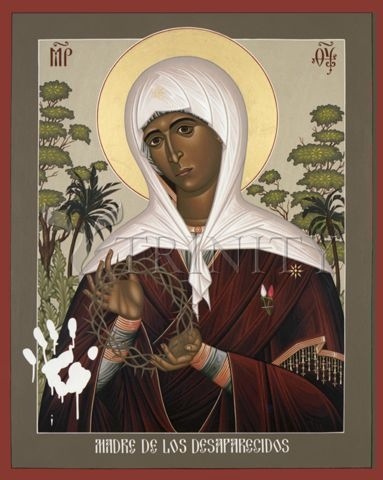
Stories of Our Lady appearing as an Aztec princess to a Mexican man during the Spanish conquest, appearing as a grieving mother during the Plagues in Europe.  Mary being depicted as every tribe and race under the sun, even in priest’s vestments.   Mary never really seemed to get the memo on her ‘official story’.  Everywhere you look, Mary shows up in various not-exactly sanctioned guises.  One of my favorite iconographers, who’s work I borrowed for this service is Robert Lenz, who depicted Mary as a Latin American woman who lost a child to the death squads in the civil wars.  And as a woman in a Holocaust concentration camp.  And as a homeless woman.  And as a struggling woman in America’s inner cities.  Despite her official story, Mary has managed to reach out to women and the oppressed who find in her a a real person–a kindred spirit through the centuries.

And I don’t think that’s because the official naming of Mary by the church is so compelling.  (In fact, you can argue that the official “be good and quiet and God might love you” does a great deal of harm, but that’s another sermon.)

I think that’s because Mary does something no other woman in the Bible does.  Mary names herself.

When she greets Elizabeth, she sings the Magnificat—my soul magnifies the Lord, my spirit rejoices in God my savior—from this day on, all generations shall call me blessed.  She defines herself.  THAT’s who she is.  A poor, pregnant, unwed teenage girl, in an occupied village, whom the whole world would say was anything but—She defines herself.

That’s her power, I think.  That’s her lesson.  For those of us whom the world would name as unworthy, as less than, as failed and as disposable, Mary reminds us in her witness and in her person, that in the reign of God we are all counted as beloved, all counted as worthy.  She gives us an example of naming ourselves blessed, of telling our own stories, for ourselves, in our own voices, as this is what God prizes, she assures us.  Because this is what the reign of God requires, what it is built on—this reign where the lowly are lifted up, the rich are sent away empty, and the hungry are finally fed.  In order for that to happen, all of our stories need to be told, all of us need to be named in this world.

For this naming is the work of the gospel, this naming is good news for all of us.

Amen