RSS Feed

We do not presume

As it is summertime again, that means more supply work for me, and more travels throughout Arizona. (It also means freshmen orientation time. But more about that later.)

This morning, I went out to Williams, on the edge of the Grand Canyon, to preach at a teeny Episcopal/Lutheran combo church. Williams is the next town over, about an hour west of Flagstaff, on Rt 66. (Think of the Pixar movie Cars–That’s Williams.)
To recommend it, Williams has: a train to the Canyon, and a wildlife park called Bearizona, which should win some award for Most On-The-Nose-Name for a Wildlife Park.
The congregation in Williams is friendly and decidedly western. The crucifer has dubbed me ‘the Virginian’, and addresses me as such. I told her that whenever I’m with them, I feel like I’ve wandered into a John Wayne picture. She told me, straight-faced, “Well, yup, that’s pretty much the point.”

Ah, the life of a traveling preacher.
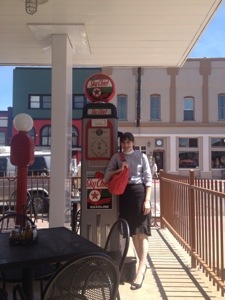
20130602-193212.jpg

Me, by old timey gas pump in Williams. All the Rt 66 nostalgia you can shake a stick at.

This is my sermon:

Rev.Megan L Castellan
June 2, 2013
Ordinary Time, Proper 4 Year C
Luke 7:1-10

In the old form of the Eucharist, there was this prayer we all said, right before we received the bread and wine.
the prayer begins, very properly “We do not presume to come to this, thy table, O merciful Lord, trusting in our own righteousness, but in thy manifold and great mercies.”

Great, right? For a moment, all across the Anglican Communion, no matter where you were, what sort or condition of person you might be, from Africa to India to Palestine, to the Deep South, to the edge of the Grand Canyon–when you got to this prayer, everyone suddenly sounded like they had been lifted bodily into Downton Abbey. We do not presume. We have all invited the Almighty over for a lovely spot of tea.

It’s a key difference between liturgical prayers and more, shoot from the hip, evangelical style prayers, but when you read a prayer from the prayer book, or from the Lutheran Book of Worship, the majority of the prayer is taken up, not with our requests for stuff, or our thanking God for what we’ve received, but the majority of the prayer is set up like this one is: we tell God what we know about God. “Dear God, here is what we know about you so far. And therefore, would you please do…..thus-and-such”

So basically, each time we pray, we sketch out the basics of our relationship to God. Who God is to us. Is God generous? Is God stingy? Are we comfortable with God? Do we trust him? Are we afraid of God? Do we love God? Prayer says a lot.

And we would recite it every week: we do not presume to come to this thy table! But thou art the same Lord whose property is always to have mercy, the prayer continues.

We didn’t invent this. We borrowed this method of prayer from our Jewish brothers and sisters, who raised this style of prayer into an art form. In Jewish liturgy, everything that is done requires a prayer, a blessing, and blessings always go the same way: Blessed are you, Lord God of the Universe, who has sanctified us with your commandments, and commanded us to light candles…or–who has given us the grain from the earth. Or–who has given us the fruit of the vine.

You recount past experiences of God because this is what your relationship is built on– to establish and build trust. Just the same as you would do with any human relationship.

Which is part of what’s happening in the gospel story. Jesus has moved into Capernaum, which will become his base of operations for his ministry in Galilee. And he is approached about the troubles of a local centurion and his slave.

Now a couple things are happening here– the centurion has heard enough about Jesus that he believes he can heal his slave, so he has come to trust him.
But also, the local Jewish population has learned enough about the Roman centurion that they trust his good intentions, and they are willing to take his case to the young rabbi Jesus, who’s just wandered into town. And they tell Jesus so: “He’s a good guy! Really! He’s not like the rest of those roman soldiers, he built our synagogue for us! This one we like. Totally fine for you to heal his slave.”

So Jesus heads off to his house, but before he can get there, the centurion sends word to him and stops him. He basically says, “Look, I know you would come, but I also know you don’t really have to. Just say the word, and my slave will be healed.”

In other words, we do not presume to come to this thy table. But thou art the same Lord whose property is always to have mercy.

It may have been that the centurion realized that Jesus would have been made ritually unclean by entering the house of a Gentile, or a house where there was such sickness. It may have been he realized it would have been a bad move politically for Jesus and for his followers to receive hospitality from a Roman soldier.

Whatever it was, the centurion tells Jesus to stop, to not bother with coming inside his house. Because in that time, and that culture, there is a chasm between Roman soldiers and Palestinian rabbis. It was a big deal. And the centurion doesn’t presume to make Jesus cross that gap.

But he does have faith, immense faith, that even across these boundaries of culture and religious practice, and occupation and politics, that he knows are there, Jesus will still heal his slave. This is what amazes Jesus.

It’s an interesting mix of absolute humility and absolute trust. The centurion isn’t Jewish, so unlike the crowds that come to Jesus, he didn’t grow up reciting God’s marvelous saving deeds every time he prayed. He may have built that synagogue, but in a very real way, he stood outside of that community of prayer.

And yet, something reassured him that despite all. that, Jesus would help him. He didn’t presume anything, he didn’t guess anything, or assume anything, but he knew exactly who Jesus was, and what he was about. Jesus was shocked because here was faith in the most unexpected place.

It’s a leap of faith. It’s that thing that philosophers talk about. For as much as we, in church, recount the reasons to have faith in God, all those very reasonable reasons to believe in God and have faith, and to trust, the lists we make of God’s saving events …what it ultimately comes down to is that leap. That moment or series of moments when God becomes God to you.

And this doesn’t happen just all at once–Bam! Something happens, now everything’s clear and you believe everything forever. For most of us, it’s a process. We gradually meet God more and more, again and again in a series of moments over the course of our lives. It’s a series of little leaps, each one bridging these gaps.

And it’s a miracle each time it occurs, mainly because we really can’t control it. God appears to the centurion, God appears to Gentiles before the church was ready. God shows up where we least expect, making those jumps. At a soup kitchen, in the face of that annoying person next to us, in the worst moment of our life. Yet God always shows up. God, throughout history, does a splendid job of running his own PR campaign, and we do a pretty awful job.

All of our reasons and all of our best guesses cannot force God to show up. And yet God always does. Still working out miracles for the healing of the world.

So hopefully, if we learn one thing in this journey of faith, we learn not to presume. Because, we know that the property of The Lord is still always to have mercy. And always to show up, in the end.

And so long as We still have faith in that, then that is the miracle.

Amen.

Job and Pastoral Care 101

The past few months have been a crash course in mass trauma, if we didn’t know already. It’s one thing after another, one horrific event piled on another, until The Onion (America’s best pastoral-care-through-satire) ran this headline today:  “Americans dredge up last remaining reserves of grief”

And they were only halfway kidding.
After two elementary schools collapsed outside of Oklahoma City yesterday afternoon, initial reports were that over 50 people had died.  Most of the initial reports I read, from news anchors on NPR, to average folks on the street, to the frenzy of Twitter, were all breathless disbelief and shock.
When that report was revised downward to around 20, Twitter threw a freaking party, the likes of which haven’t been seen since a baby kitten fell asleep in the hand of a sloth.
Except for John Piper.
John Piper is an (in)famous megachurch pastor, well-known throughout the evangelical and Calvinist Christian world.  He also has a Twitter account.
Right in the middle of the initial reports of collapsing schools coming out of Oklahoma, he tweeted this:  “Your sons and your daughters were eating, and a great wind struck the house, and it fell on them, and they are dead.”  Job 1:19
I’ll give you a minute to process.
The only way I can process someone responding this way, is by imagining that Rev. Piper fancied himself in some elaborate game of Bible Verse Trivia, wherein he had to match a Bible verse to the current circumstances, without regard for context, or, y’know, actual people being affected.  If such was the case (and that would be a HUGE STRETCH) then, hooray, he wins whatever imaginary prize he was competing for inside of his head.
However, the Rev. Piper missed something in his elaborate, imaginary game of Pin-the-Verse-On-The-Catastrophe.
The Book of Job actually continues.
It continues for quite a while, in fact.
Because, in the book of Job, after all these catastrophes happen, his three ‘friends’ attempt to comfort Job, in much the manner of Rev. Piper’s tweeting.
They show up, and they offer all the platitudes under the sun:  you’re just being tested!  God is doing this because he loves you so much!  You must have done something wrong to deserve this, because a good God wouldn’t let all this happen to someone who didn’t secretly deserve it! (take note, Calvinists.) If ever you’ve read something trite in a Hallmark sympathy card, rest assured that one of Job’s ‘friends’ uttered it first.
And then, Job just tells them that they’re full of crap.
Actually, he does more than that.  He informs them that not only are they full of crap, but that he is pretty convinced that God is also full of crap, and if God would like to show up down here hisownself, he will inform God of this fact, right to his face.  Job gets sarcastic.  He gets maudlin.  He accuses God of stalking him.  He accuses God of being a giant, omnipotent whimsical bully who should go pick on someone his own, overgrown size.  At one point, he even gets vaguely poetic, and rewrites Psalm 8 to fully detail his great anger and annoyance at God, for letting all this crap happen to him for absolutely no reason.
Seriously, if you need a Masters Class on how to be angry at God, read Job’s soliloquies.
And all this yelling, all this stomping around on a dustheap, and the elaborate poetry, and the biblical snark, is so God will show up and answer Job, somehow, and vindicate him.  Prove to him that he’s not nuts, and that he didn’t deserve all this misery, and then, somehow, Job will be comforted.
All Job wants is for someone to comfort him.  Because his ‘friends’ aren’t cutting it.
At the end of 32 chapters of this shouting, after Job’s ‘friends’ have run out of sympathy-card-schlock, and after Job has run out of things to yell at them, and at the sky, this interesting thing happens.  Possibly the most interesting thing in a book full of them.  (This is why you always read to the end of things, Rev. Piper.)
Job shuts up.  As do his ‘comforters.’*  For a moment, for a beat, in a story that is chock-full of people monologuing, they sit in silence.
And when Job is quiet, God shows up.
In a freakin’ whirlwind, making the best entrance in all the Bible, God shows up, and points out that God created all that is-so this battle of wits Job wants to set up is slightly unfair.
Job responds “I have heard you by the hearing of an ear, but now my eye sees you; therefore I relent, and am consoled of dust and ashes.”**
So, something about God’s speech, and the showing up, and the talking to Job helped him.
Nothing the ‘friends’ said.  None of that relentless talking.  None of those platitudes.
What helped Job was the silence.
And getting to yell long and loud at God.
And God responding, in some weird, whirlwind-y fashion, even if it was not at all the answer Job said he wanted.
And when God did show up, he promptly reprimands the ‘friends’, for lying about God, and not speaking the truth, the way Job had done.
So if we’re actually going to take the book of Job as a pastoral care 101, our first move after a disaster shouldn’t be explanations, or defenses of God, or well-meaning speeches.
We should probably just sit quietly for a while in the dust.  And yell angrily for a while if we feel like it.  And cry a bit, if we feel like it.
Because the silence, the anger, the pain, the suffering, the fear– that’s where God shows up.
So that’s where we should be, too.
*I should pause to note that there has now entered into the story a fourth guy, Elihu, but I’m ignoring him because the text itself does, and he doesn’t add anything to the narrative, except for making it more theologically acceptable to whichever scribe it was who inserted him in the first place.
 ** Job 42: 5-6  That’s not exactly how the NRSV translates it, but read the footnote–the committee screwed up here.  The Hebrew here translated as “despise myself” can also be read as relent or recant, and the Hebrew translated ‘repent’ should be translated console.  Basically, Job now feels comforted about being a transient mortal (‘dust and ashes’).  Which makes more sense, given what God does next.


Who do you say that I am?

Driving home from Prov 8, I let the students play music off my iPhone. The DJing student selected the playlist I had constructed last year entitled “Southern mix”– because it was music that reminded me of being in a kid in Virginia in the summer.
We listened in silence for a few songs, broken only by my shock that several (SEVERAL) of them hadn’t heard the musical genius that is Marshall Tucker Band’s Can’t You See.* (If you haven’t heard it either, go listen. I’ll wait.)

Finally, one of the students said, “There’s a surprising lack of country on this playlist. Aren’t you from the South?”

I was puzzled. There was actually no country on that playlist. There was lots of blues, there was lots of stuff recorded at Muscle Shoals, there was Atlanta hip-hop, there was the Alabama Shakes, and the Black Keys, and Tuesday’s Gone by Skynyrd (piano solo!), and some gospel and Nina Simone, but no country at all. And wasn’t that the South, too?

I don’t associate country music with what I know of the South. Apparently, many other people do, though. Who gets to decide what ‘the South’ is?** Who gets to tell this story?

Those proscribed identities, all those narratives that we assume we know–they’re problematic–both for those inside the group and those outside. It’s a problem when we let the idea of ‘the South’ be represented by only Brad Paisley (saints preserve us) or, worse, Rick Perry or Ken Cucinelli (…let’s just all move to Canada. They have health care.)

In the church? Also not helpful to let our identity, our story get co-opted.
It’s not helpful when the guys carrying the banner of “Christian” are preaching the fiery destruction of hell for 3/4ths the population, or explaining the evils of birth control, or gay marriage. When the loudest Christian voices are preaching anything but love, our voice has been co-opted. And we have a problem, because the story of the Gospel of love isn’t being told.

For a little while now, our collective solution to this has seemed to be to back away quietly, and hope the illogic of the louder voices would soon become clear. (This might be because we are Episcopalians, largely, and someone told us that it was quite impolite to contradict, or argue in public.)

Yeah, that didn’t happen. It turns out, no one hears the truth that you don’t speak out loud. People don’t actually learn through osmosis, and as much as we might think it obviously flawed and ridiculous, if no one presents any alternative, then everyone will go with the single, loudest definition for Christian.

So it’s up to us, who have a problem with the current, dominant definition to say something. To start telling our own story, to play our own song, and present a counter narrative. If we think the loudest religious voices are wrong, what do we think is closer to right?

What does being a Christian mean to you?

*Lyrics like Gonna find me/a hole in the wall/ Gonna crawl inside and die just cannot be argued with if you want to get real about Feelings.
Also, there is a flute. Because this was the 1970s, and this was how you rolled, if you were a legit blues band, evidently.

**If you want to read what a smarter person than me thinks about this, read what Ta-Nehesi Coates wrote about Brad Paisley, and the South here.
It’s what got me started thinking about this, and also what makes me want to get a Faulkner or Ida B Wells t-shirt. Definitely ordering my Harriet Tubman coffee mug, though.

One day

One day, I will be able to go six months without having to plan a vigil to remember some horrific act of violence. That will be a great day.

That is not this day, however.

NAU Canterbury will be holding a vigil on campus this week (most likely Wednesday, it now appears) to remember those suffering in Boston, as well as those who died in Newtown, and around the country as a result of the violence in our world.

Here’s the liturgy I’ve written for this.

(NOTE: this is the initial draft, and as such, hasn’t been approved by my ecumenical colleagues.  So please don’t hold this against them.)


Vigil for Victims of Violence 2013

April 2013


Opening: (words to this effect: admittedly, I tend to overwrite liturgy)


Leaders: (alternating) We have come here in deep emotion: grief, sorrow and shock.  We have come here in anger, frustration, and even numbness.  Again and again, in the past few months, we have seen the violence in our world, arriving on our very doorsteps, splashed across our televisions and computers.


What we have witnessed is overwhelming.


As people of faith, we know that God is with us, even now.  We know that God is with those who are suffering.

We know these things, even when it is hard to feel that they are true.


And so tonight, we bring our tears and our anguish, our frustration and our fear, and our sense of powerlessness to the God who chose to suffer with this world.


Let us pray.


Holy God, as Mary stood at the foot of the cross, we stand before you with broken hearts and tearful eyes.  Keep us mindful that you know our pain, and free us to see your resurrection power already at work in the world around us.  In your time, raise us from our grief as you have raised those we’ve lost to eternal life; through Jesus Christ our Lord.

Amen.


Let us remember those we have lost.  As a sign of respect and remembrance, as you read the names given to you, please stand.

Students read the names, alternating.


  • For the 28 people killed in Newtown, CT at an elementary school.
  • For the many who have died at Virginia Tech, Columbine, and other schools around our country.
  • For the six people killed in Tucson, AZ at a grocery store.
  • For the thirteen people killed in Aurora, CO at a movie theater
  • For the seven people killed in Oak Creek, WI at a Sikh temple
  • For the three people killed, and hundreds wounded, at a Boston marathon
  • For the thousands who die every day on the streets of Chicago, Detroit, Washington DC, and all of our cities, whose names are known to God alone.
  • For hundreds of victims of accidental shootings and stray bullets.
  • For victims of domestic violence and abuse.
  • For all those left to mourn the dead, and care for the wounded.
  • For those so lost and confounded that violence appears to be the best answer.


Leader: For all these named, and for all those we’ve lost that we name now, we pray.

We name the victims we know personally here.


Everyone should be standing now.  We observe a period of silence. Then…


Reader 1: Who will separate us from the love of Christ?  Will hardship, or distress, or persecution, or famine, or nakedness, or peril, or sword?…No, in all these things, we are more than conquerors through him who loved us.  For I am convinced that neither death, nor life, nor angels, or rulers, nor things present, nor things to come, nor powers, nor height, nor depth, nor anything else in all creation will be able to separate us from the love of God in Christ Jesus our Lord.


Reader 2: The light shines in the darkness, and the darkness has not overcome it.


Reader 3: Jesus said to his followers:

Blessed are the poor in spirit, for theirs is the kingdom of heaven

Blessed are those who mourn; for they will be comforted.

Blessed are the meek; for they will inherit the earth.

Blessed are those who hunger and thirst for justice, for they will be filled.

Blessed are the merciful, for they will receive mercy.

Blessed are the pure in heart, for they will see God.

Blessed are the peacemakers, for they will be called children of God.

Blessed are those who are persecuted for righteousness’ sake, for theirs is the kingdom of heaven.


Leader: As people of faith, and as followers of Jesus, this is who we are called to be.  This is how we are called to live.  Even in a world of violence.  Especially in a world of violence.  We are called to bear the light of Christ’s peace and illuminate the darkened world around us.  We are called to be the helpers.

Let us pray.


Prayer of St. Francis

Lord, make us instruments of your peace.  Where there is hatred, let us sow love.  Where there is injury, pardon; where there is discord, union; where there is doubt, faith; where there is despair, hope; where there is darkness, light; where there is sadness, joy.  Grant that we may not so much seek to be consoled as to console; to be understood as to understand; to be loved as to love.  For it is in giving that we receive; it is in pardoning that we are pardoned; and it is in dying that we are born to eternal life.

Amen.


Let us go forth, to be light for the world, salt for the earth, peacemakers in a troubled time.

And may the blessing of God Almighty, Creator, Redeemer, and Sustainer, keep us now and forever in peace.


Pundit Jesus

Two posts in two days! This is shocking!
What this actually is a sermon from two weeks ago that I neglected to post. So here, Internet! Late sermon!

March 3, 2013
Lent 3, Year C
Luke 13: 1-9

I saw a cartoon this week: in the night sky shines the bat signal at one corner, and a cross at the other. On the roof below stands the police chief with Batman, and a bemused looking priest. Below the panel, it reads:
“Alright, guys, the Joker has escaped from jail again. Batman, you know what you’re supposed to do. Fr. Conroy, you’re here because I want you to explain to me how a loving God lets this happen to me!”

It’s good for a laugh, but frequently, religious leaders of all persuasions are called upon, whether by flashing the “Pastor Symbol” in the sky, or just a simple phone call, to answer this question.

Some tragedy hits, big or small. A earthquake strikes, or you stub your toe. A massacre claims the lives of almost thirty people or a terminal diagnosis claims the life of one. And the question rises again: Why?

So it’s comforting, in a way, to see even Jesus hit with this eternal question. The crowd comes to him and wants him to weigh in on the events of the day– the hot-button issues that everyone’s talking about.

Pilate– yup, that Pilate, who will become even more important in a few weeks– has just made the gossip rounds again by ordering that some Jewish rebels be crucified, and that their blood be mixed with the sacrifices in the Temple.

Nowadays, we tend to get stuck on the part where he’s executing the rebels, but for a community as devout as Jesus’, this would have been a huge insult to the whole country. To mix human blood with the blood of animals renders the whole operation unclean, REALLY unclean, unworthy of God, and to add in the fact that an occupying, pagan power is making you do it just rubs salt in the wound. Pilate might as well have spit in the face of the whole Temple establishment, and every Faithful Jewish person in the country.

Which is why the crowd wants the nice young rabbi’s opinion of how God could let such a terrible thing happen. Because the thought that such a terrible act of violation and violence could happen to them, to their country, and to their fellow countrymen just hit way too close to home.

So, to get around this scary closeness, this massive sense of violation, the crowd follows some reasoning that is still popular today: those people must have done something to deserve it.
They must have been asking for it, somehow! And so God was punishing them! That must have been it. God hasn’t abandoned us to the power of Rome, and there’s absolutely no way that something so horrible could happen to anyone that I know or like– because those people must have deserved it.

Jesus cuts this line of thought off right at the knees. “Do you think that those Galileans were worse sinners than anyone else? No, but if you do not repent, you will all perish as they did.”
At first, This doesn’t sound particularly comforting. Ok, those who died at the hands of Pilate, and in the tower collapse weren’t any worse than the rest of the world…but on the other hand, the rest of the world is doomed too?

But Jesus follows it up with this story of the fig tree and the gardener. The fig tree is similarly in trouble. It isn’t producing figs like it should, it’s just sitting there, and the owner of the garden is losing patience, wants to cut it down. But the gardener intercedes– Give it one more year. I’ll tend to the tree more closely, fertilize it, help the roots a bit. Chances are, that’s what it needs to start producing. Don’t cut it down just yet. Give it another chance.

There’s no ending to this parable, and I’m inclined to think that is on purpose. We don’t know the owner’s response, or what happens with the fig tree in the end.

Because the point Jesus is going for is that very ambiguity, and he turns it back to us. Sin and brokeness are constants in our world, Jesus argues. They have always been here. They plague us. Our human propensity to abuse each other, to hurt one another, to inflict pain and suffering on the people around us and on God’s creation, isn’t isolated to one unfortunate group or another. It’s not something we can separate ourselves from. And that is what causes so much hurt for us all.

So the question is: what are we going to do about it?

See, We are the gardeners. We are in charge of this unproductive and suffering fig tree, in this scenario. We are stewards of a world that is haunted by sin at every turn, that can be hurt or healed by the actions we take. So much suffering in this world, and rather than just blame it on a wrathful or a punishing God, or letting us separate ourselves from it by saying “they deserved it”, Jesus turns to us, makes us face it head on, and asks how we plan to help.

Because the truth is, everyone suffers at some point, even while everyone’s suffering is unique. And what Jesus calls us to do is to remember that part of our job is to help alleviate this common human suffering while we are here.
Not turn our backs on it or become numb to it.
And even though we can’t fix everything, we can change something. And so we are called to try. To do our little bit– put down the fertilizer, dig around the roots a bit, and give this tree one more shot.

Towers fall. Hurricanes destroy. Madmen kill. We witness these things every day. But Christ calls us to not become numb or cynical, or closed off, but to acknowledge, and wade right into the darkness of the world, bringing the light of Christ, bearing witness to the pain and confusion of the world and try to help.

Because. In the end, it is that witness, that presence of the divine in the midst of brokenness that means more than any explanation.

Amen.