RSS Feed

Orientation-ing

For the past month, Northern Arizona University has held a series of New Student Orientations: two a week, all through June.  Incoming students flood Flagstaff’s pretty little town (and tiny, overstressed roads) and make shopping at the sole Target near-impossible.  Along with their parents, guardians, and/or siblings, they tour the dorms, sign up for classes, and attend the ORIENTATION EXPO!

The ORIENTATION EXPO! occurs at 7:30 AM (yes.  AM.) outside along one of the walkways on NAU’s campus.  Each student activity signs up for a table, and the right to stand at said table, hawking their services.  Everyone from Parking Services, to the Bookstore, to Campus Crusade for Christ shows up, and hands out pamphlets and swag.

Basically, it’s running the gauntlet of brochures, overwhelming information, and candy, at an hour that no seventeen year old is functioning.  (And there’s no coffee. Did I mention that?)

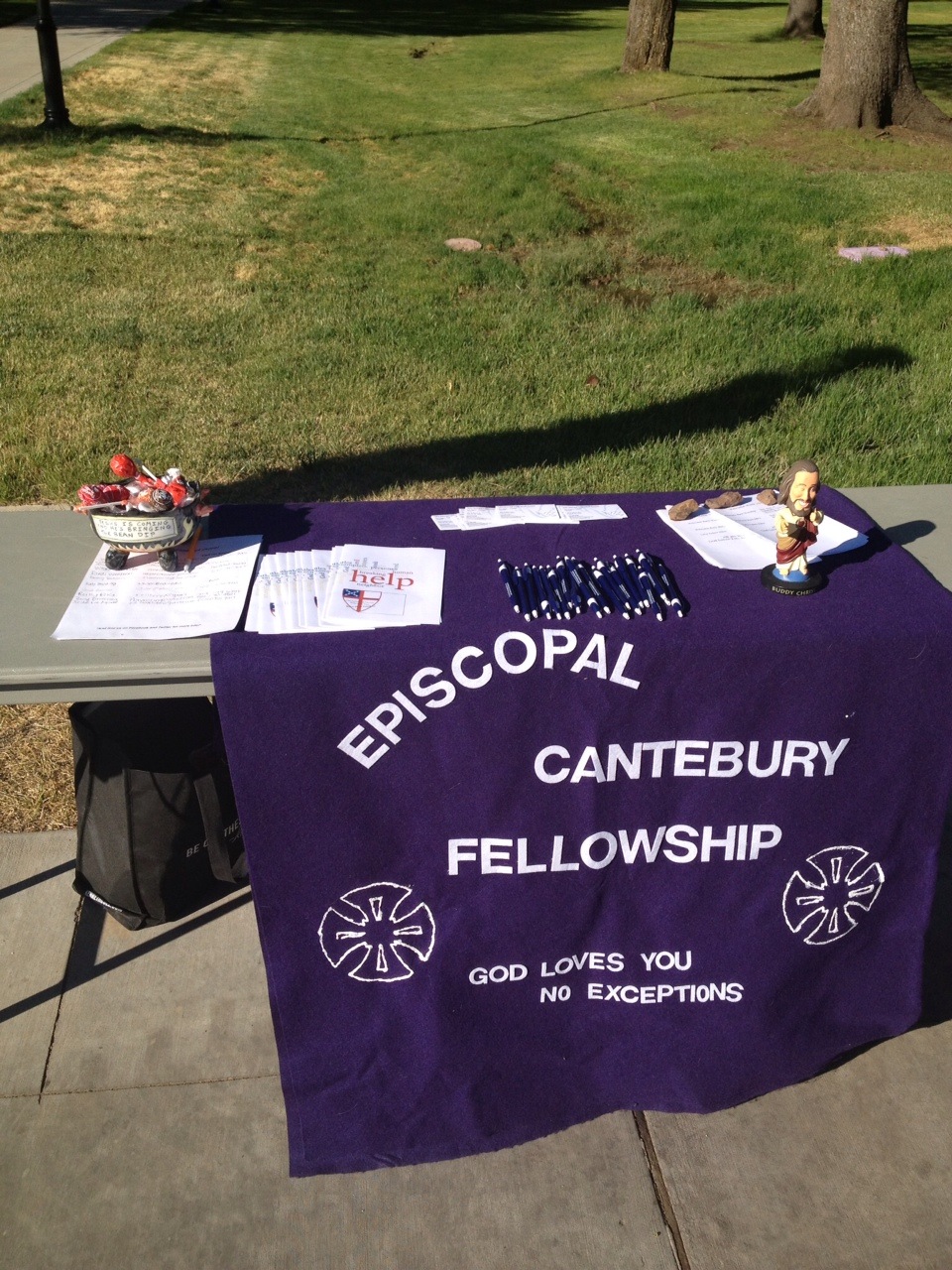
NAU Canterbury has been present for the past 3 summers.  We have colorful brochures, colorful business cards, and a bobble head Jesus.  Here is our table.  (And yes, I set this up for a month, and JUST NOW realized that Canterbury is misspelled.  See what happens when I am asked to do things without benefit of caffeine?!)

Our table.

These expos are instructive.  For as much as we have been talking recently about getting out of the church building and mixing with Actual Unchurched People, this is a way to do it.

Things I have Learned:

  • Few know what ‘Episcopal’ means.
    I mean, like no one.  Almost no one has heard of it before.  But those who have, think it’s great.  The people who know what the big, scary, Greek word on the banner is, generally have positive associations with it.
  • So this is mainly about education.  Education that we, at least, aren’t frightening or abusive (and I’m using those terms intentionally.)  Education that we aren’t those ‘Christian’ voices who picket funerals, and bomb clinics, and advocate killing groups of people in the name of God.
  • This is, obviously, tough to do in 45 seconds.  So mainly, I talk about how we have meals with all our activities, we’re welcoming, and affirming, and give them our brochure.

I can’t overcome all preconceived notions about what Christianity is or is not in a 30 second conversation.  And this results sometimes in events like the young man who told me flat out that he couldn’t attend my ministry because he didn’t believe that women should speak in church.  Alrighty then.  And it becomes harder still when the majority of Christian voices on campus reinforce these ideas.

What I can do is be a friendly, nonthreatening and welcoming presence that hopefully, causes curiosity.  Maybe the new student will remember that this one time, there was this odd priest-lady who seemed nice, and it might not be so scary to take a friend along to go check that group out, one day, when everything seems awful, and hope seems really distant.  That’s worth being awake at 7:30 am.

Camp is Wonderful; Church Signs are Terrible.

I spent the past week at Chapel Rock, our diocesan camp, training counselors for the upcoming Children’s Camp.  This year, Children’s Camp is Narnia-themed, which means that our Canon for Children’s Ministries went whole-hog and built a WARDROBE over a door.  (Pictures in a future post, so campers won’t be spoiled.)

Suffice to say, I spent the day of the wardrobe’s construction running back and forth through it like a maniac.  People, it even had MOTHBALLS stuffed in the corners for authenticity of smell.  (Behind safely stapled black fabric.  Accidentally poisoning children isn’t Christian.) 

It was a fantastic week.  Bible study every day with counselors, in which we dream-cast a movie of the Prodigal Son (Father: Morgan Freeman, Elder Son: Christian Bale, Younger Son: Charlie Sheen), and composed time-shifted versions of the Resurrection accounts.  

Then, home I came, and to Sedona, I preached.  They got more or less the following sermon.  


Mark 4:35-41

When I was a kid in Pennsylvania, we lived behind a Southern Baptist church, with a church sign out front. Each week, my brother and I would wait anxiously to see what message they’d put on that sign.  Every week, it featured some pun, or saying. “God answers Knee mail.” or something about Jesus: “Jesus: he’s coming. Justice: its coming too.”. So basically– of puns and vague threats. A certain, specific type of evangelism.

The one I really remember said “Tears bring rainbows.”. And it appeared the week my mother had a mastectomy, and I decided I just hated that sign. Because it came to encapsulate all of the token phrases people repeated, over and over, like magic words: hoping they would have some effect in the world, but repeated so often that they lose their meaning. Those platitudes we say all the time, without thinking, almost, like charms. God will provide. It’s God’s plan. Have faith.

It’s the easiest thing in the world repeat these. And to say them to someone else.  To tell someone else to have faith! Trust in Jesus! But what on earth does that actually look like? In 2012, at the end of June, here, today, what, does that actually look like? Because repeated words are well and good, and sometimes very comforting, but oftentimes, we need a little bit more of a concrete reassurance than that.

So how do we have faith? How do we trust in God?

Like most behaviors, trust and faith are learned. When babies are born, they learn that someone, hopefully, will be there when they cry to hold them, and feed them, and change them, and stay up all night with them, becoming horribly sleep deprived…but in this way, hopefully, we begin to learn the concept of trust. It’s also how peek a boo works. I’m gone! But I’m coming back.

And also like most behaviors, faith and trust are tricky beasts to master. All the world does not operate like a game of peek-a-boo, and so many of us also learn that occasionally trust can be misplaced. And that hurts. And we get cautious.  We get careful.

Observe the disciples. They have been following Jesus around for a bit now. They’ve left house and family, their livelihoods, and their security behind. They’ve seen him preach, and heal, and cast out demons. They’ve witnessed the massive crowds that are following him.

They’ve seen a lot, they’ve heard a lot. The action in Mark’s gospel up until this point has been nonstop. This is the first break Jesus has had since his ministry started– he’s been followed pretty continually by large crowds, and now he gets in a boat for some peace and quiet, and a nice nap. The introverts among us can identify with this.

And through all of this, the disciples have been witnesses of how Jesus has acted towards them, and towards others.

But their first reaction, when the storm hits, is “Ack! Jesus! Why are you abandoning us to let us drown in a boat!!!!”. You don’t love us, we’re all going to die, ahhhhh!!!”

It’s definitely a human reaction, to be sure. It’s a reaction of sheer panic. To be in a storm in a boat at sea is not a pleasant experience. I can see how they thought they were going to die.

But what in the world had given them the idea that Jesus was going to just let them all drown? The same guy who had healed the sick, conquered demons, and saved Peter’s mother in law from death was now just going to sleep through their collective doom?

In this moment, fear trumped the faith that they had learned. Fear overrode what they knew to be true about Jesus. They knew who Jesus was– they knew that Jesus was not going to abandon them, and hadn’t abandoned them. They knew that Jesus didn’t do that, wasn’t going to do that. But fear is a primal force at times, and can speak pretty loudly, while faith is quieter.

It’s a challenge to keep listening to the quiet voice of faith, even in the midst of fear. It’s a lot easier sometimes to fall back into our patterns of cautious behavior. Easier to go back to believing that trust hurts, faith gets broken, and God acts like everyone else who’s ever hurt us.

 And so, when storms strike, we fall back. When disaster strikes, we revert. We accuse God of hurting us. What caused the earthquake, the hurricane, the wildfire? God must have been punishing someone’s wickedness. What caused the cancer? God must have been trying to teach a me a lesson. Why are we sitting in a boat in the middle of a storm? Jesus is trying to kill us.

 It’s easy to listen to fear, and to forget that none of that fits what we know about God. Certainly, none of that fits what we know about Jesus. The loving God who promises to be with us always, who stayed with the Israelites, even when they complained for 40 solid years, the healing Christ who made whole torn up and sick people. God doesn’t send disasters and sickness and death as punishment, or to teach us lessons. God doesn’t abandon what he has created. God doesn’t manipulate people like that. God suffers when we do–and has suffered with us, in the person of Jesus.

God doesn’t leave us. And will never leave us. Jesus is right in the boat with us, even when we are scared, and even when we panic, and cover our eyes with our hands. Jesus is still right there in the boat with us.

That’s what we know. That’s what we have faith in– a living, loving God-in-Christ. Even when we’re scared, and most especially then. Thomas Merton expressed it in this prayer:

Lord,I have no idea where I am going, 

I do not see the road ahead of me,

I cannot know for certain where it will end.

Nor do I really know myself,

And that fact that I think

I am following Your will

Does not mean that I am actually doing so.

But I believe

That the desire to please You

Does in fact please You.

And I hope I have that desire

In all that I am doing.

I hope that I will never do anything

Apart from that desire to please You.

And I know that if I do this

You will lead me by the right road,

Though I may know nothing about it.

Therefore I will trust You always

Though I may seem to be lost

And in the shadow of death.

I will not fear,

For You are ever with me,

And You will never leave me

To make my journey alone.

Amen.
 

New Structure, New Church, Same Jesus

Last week, before I left on retreat (Beautiful Authority Conference, which was amazing) I received in the mail a book from the President of the House of Deputies.

Now, I love to read, and I love books, and so I am disinclined to question when free books start appearing in my mailbox.  But this book was an actual, physical BOOK #1, and #2, it was explaining to me the glorious history of the governance structures of The Episcopal Church, and how it makes us who we are.
And, it does.  But the problem is, who we currently are, in all its vast complexity, is not all we ought to be.
Like I said last time (or the time before the Trinity Break), currently, we’re doing an excellent job pretending to be some odd corporation.  Occasionally, on smaller scales, we like also to be a country club.  And, at points in our history, we have also tried to be a full-on kingdom.
We aren’t good at any of those things, nor are we called to be any of those things.
We’re called to be a church. The embodiment of Christ at this time and place on the earth.  We are called to be turned outward, and serving the world in Christ’s name, like chaplains to the world.
In almost no way are we currently set up to do that.  We’re set up to form committees, and to issue recommendations, or build stuff, or argue.  (We are fantastically good at arguing.)
But as far as dealing with a world that is not predominantly Christian, and not so inclined to listen to our recommendations, learn our language, or venture into our amazing buildings, we are not set up for that.
We need to build a servant structure: and not just servant in terms of “serving the mission of the church”, but servant in terms of serving the world.
And (brace yourselves) but the first thing we need to do is combine the House of Deputies and the House of Bishops.
Each diocese gets their active bishops, two clergy, and two lay votes.  I didn’t come up with this brilliant plan; Tom Ferguson+ and others explain it quite well. (We can keep the Presiding Bishop to play with the other primates, for however long we get to stay in the Anglican Communion, and to organize annual Bishops’ Gatherings.  Otherwise, the presiding officer of the new Joint House should be elected from any order of ministry, for the term of the General Convention, banging the gavel and whatnot.)
There are several practical advantages to this plan: it decreases the cost of General Convention dramatically, it lessens the financial pressure on individual dioceses, it decreases the silo effect between House of Bishops and House of Deputies.
Also, it forces us to put our money where our mouth is with regards to ministry of all the baptized.  Since the 1979 BCP came out, we’ve worked hard to establish that you do not receive special powers when you are ordained.  However, neither do you lose your baptismal powers and obligations when you are ordained.  I am bound to respect the dignity of my fellow human beings just as much now as I was prior to donning the plastic collar, if not more so.  When we say everyone is equal before God, then everyone really does need to be equal in the eyes of the church’s structure, and that should include being in the same room to hash out how we’re going to be church together.  And if you’re too intimidated by your bishop to vote a different way, then may haps you, and your bishop, need another lesson in baptismal theology.
So now that everyone’s in one room together, we really no longer need doubles of the committees.  Hooray!
And, we’re going to impose two new rules to guide the work of said committees:
1. Don’t Say it, Do it.
2. Everyone is 3 years old.
Rule #1: Don’t Say it, Do it. 
The first rule is stolen gleefully from Scott Gunn+.  In essence, we need to get out of the mindset that we still run the world, in the manner of Coca-Cola, or Constantine, and that, via efficacious speech, the world will bend to our righteous will.
The Korean Peninsula will not reunify just because we pass a resolution saying we are in favor of that.  The Cuba embargo will not be lifted either.  Nor will a two state solution be reached in Israel/Palestine through the power of our paperwork, EVEN IF we send a copy to the president.
What we should do instead is ACTUALLY DO THINGS.  Want a two-state solution?  Disinvest in Caterpillar, Motorola, and companies that do business in the Occupied Territories.  (This worked to end South African apartheid.)  Want to help heal the planet?  Ask churches to convert to those swirly lightbulbs, and give them incentives to do so.  Ask them to investigate solar panels, and give them incentives.
We can’t just state what we think about things any more and assume people care.  We need to do things, and then explain why we are doing them.  Any committee that can’t fulfill its mandate in actionable steps needs to reconsider its mission.
Speaking of that:  Rule #2!  Everyone is 3 years old.
 We need to explain why.  All the time. Why do we care about global poverty, and universal healthcare?  Why do we care if everyone is included in the church?  Why do we care about transparency in the budget?  Why?  Why? Why?
We need to pretend that the entire world is populated by extremely cute and lovable toddlers who keep asking us, “Why?”
We cannot assume that people understand the connection between Jesus and taking care of the poor.  We cannot assume that people understand the connection between Jesus and loving your neighbor.  We cannot assume that people understand who in the world Jesus Christ, as portrayed in the gospels and as we know him, actually is.  We need to remember that for many, many years now, there has been a concerted effort to use the name of Jesus to bash people who are different, and to justify all manner of hateful actions.  To begin to undo that is perhaps one of the most powerful acts of mission we can engage in.
Last night on the Colbert Report, Stephen Colbert had on his show both Sr. Simone Campbell, who heads NETWORK*, and Martin Sheen.  Both are devout Roman Catholics, and both have been noted for their activism on behalf of peace and poverty issues.  (It was an awesome Roman Catholic grand slam.)  What struck me is the audience response.  When Stephen Colbert (who teaches Sunday School at his church, mind you) asked Sr. Simone why nuns were such ‘radical feminists’, and spent so much time serving the poor and sick, she came right back at him.  “That’s the gospel. That’s what Jesus taught us to do.” The crowd burst into sustained applause.
Ditto when Martin Sheen came out.  “Why are you such a liberal commie-type?” queried Colbert, “Well, it pretty much is about that gospel that the sister was talking about.  I’m following Jesus and this is what Jesus taught me.”  Again, the crowd went nuts.
In a period of less than ten minutes, an actor and a nun evangelized a non-churchy audience much better than most Episcopal churches ever do.  Why are we doing this?
Because of Jesus.
Ultimately, the structure we need is answered in that.  Make a structure that serves the world, and invites the question, so that everything we say, do, and are is answered by, “Because of Jesus.”
*NETWORK is an progressive Catholic group which “educates, lobbies and organizes for economic and social transformation.”

Fly, Geeky Angel! Fly!

Before I totally depress us all with another installment in the Sweet-Jesus-what-is-happening-in-the-church? Series, want to hear what happened on Sunday? Because it was not at all depressing.

Sunday, as I’m sure you are aware, was Trinity Sunday. Feast day not only of orthodox Nicene faith, but of curates, seminarians and seminarian wannabes. The day when rectors and bishops beat the bushes to find the lowest preacher on the totem pole and force them to explain, in 10 minutes or less, the inscrutable mystery of the One, Holy and undivided Trinity.*

Bottom line is that I’ve preached on Trinity Sunday since I was 20 years old. I’ve developed a weird affection for it.

This Sunday happened to be my first in a steady supply gig at St. Andrew’s, Sedona. Their rector is on sabbatical, so they have me for the next three months, interrupted only by the one Sunday I’ll be at General Convention. I really like this congregation. They’re very friendly, and (being in Sedona) slightly quirky.
Best of all, their friendliness is the engaged, welcoming kind, which is invaluable. They walk me to coffee hour after each service (not just me, mind you– each visitor gets this treatment). They broke into applause after my sermon at the 10am service. (See? Quirky. There can be no other explanation for why sane people would applaud an explanation of the Trinity.)

However, the best part’, the part that cemented my love for this feast, forever and ever, Amen,

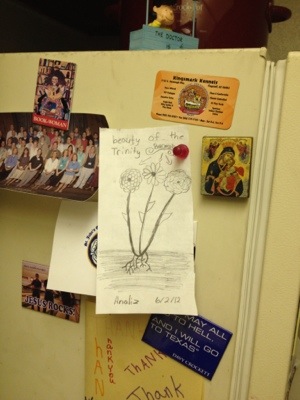
was a little girl who walked up to me after the service, and handed me this:

20120604-185159.jpg

She drew it during the sermon.

I can retire now.

Anyway, here’s what I said.

Trinity Sunday! Year B

Isaiah 6
My father manages a flexible packaging plant outside Philadelphia.  He has for 17 years now. And he likes that job fine. They make that shiny film that makes it so you can see stop signs at night.  Very specific job.
But this is not really what he likes to do.  What he likes to do is on the weekends, when he coaches a basketball rec league for kids.  And every year, he does the same thing– he constructs a team of the kids that no one else picks out of the draft, kids who have never played before, or who just have no talent, or who, like me, are massively uncoordinated,  and he takes the parent who wants to help, but has no idea how to dribble, and he teaches them basketball.  Every year.

Now, my father was a professional basketball player.  He played in college, was drafted by the Celtics, played in Europe for a few years, then got hurt and retired.  He’s actually good at basketball.  And my mother, my brother and I tease him, that there are simpler ways to coach than to put on your own underdog Disney movie each year, with kids who get so excited when they get the ball that they just start running up the court holding it, and then get called for travelling. And for whom winning one game is a massive and unexpected triumph.

But Dad, i think, gets sort of offended by the teasing.  He doesn’t see the point.  To him, the point is simple.  Kids should learn the game.  So everyone should play. And everyone should get better. Everything else: winning, losing, egos, all come second.

And while most often, that ends up looking, to the casual observer, like complete chaos on the court, like little kids freezing the minute they get the ball, or panicking and outright tackling the other kid who has the ball, or something else that should really end up on a blooper reel, by the end of the year–the kids have grown.  They’ve learned.  They’ve gotten better, and they’ve gained confidence. They may never be perfect, but that was never the point.

Perfection, though, is a human obsession.  We really like to be perfect.  We like to do things right, to have things proper, in their places.  Otherwise, what’s the point of doing them at all?  Perfectionism! Very human obsession.

Watch Isaiah, in that first reading. He is having a vision of the glory of God, called before the throne of the Most High, angels flying all around– not just the normal angels, but the weirder, seraphim with the many wings, and the funky looking things, and all that.  And there are beasts and fire, and all sorts of stuff.  Overwhelming!

And in the middle of it, this overwhelming scene, Isaiah freaks out.  He remembers that he’s a bit of a screwup, and panics.  He gets the ball, and freezes like a six-year old.  “Have mercy on me, for I am a man of unclean lips, and i come from a people of unclean lips.”. In other words, I don’t always speak rightly. I don’t always manage to tell the truth, either about myself, about others, or about God.  And neither do my people.

I’m not perfect.  Says Isaiah.

And God calls him anyway.

Because that is both exactly the point, and entirely beside the point, all at the same time.
God is, in fact, well aware that Isaiah is a screw up.  God is, in fact, well aware that the people of Israel haven’t been getting it right, and aren’t going to get it perfect now, and most likely, aren’t going to get it perfect the next time either.  God’s been with them for a while now, through the exodus, the ten commandments, the golden calf mess– none of this is really news to God.  God is well aware of the tendency of humanity to consistently take a good idea and charge in the wrong direction with it.

But the reason God tries, time and again, to get it right with us isn’t because we are so very perfect and good– it’s because that’s just how God operates.  That’s who God is.

God must be in relationship. God must love.  God, by his very nature, so overflows with love that it must go somewhere, out into the universe, and so God creates a cosmos with which to be in relationship.  God creates out of love, because love is inherently creative.

The nature of God is love, and so the nature of God is relationship, is community.

God sends Isaiah and the prophets, and keeps trying with humanity, and eventually shows up in Christ, not because we’re going to get it perfect anytime soon.  But because it is in the nature of God to seek relationship with us.  To love us.  To try to teach us how to get better, and to walk with us.

You don’t teach something you don’t love.  You don’t teach someone you don’t love either.  And you also don’t teach someone who has everything figured out already.  They don’t need you.  But creation, wrapped up as it is in the embrace of God, is still being created.  The kinks are still being worked out.  We’re still being shaped and guided and taught by a loving God.  We still have a ways to go before this project is anywhere near finished.

Today is Trinity Sunday– a day when we attempt to explain one more time what on earth we’re talking about when we talk about God as a Trinity– the three in one.  One of the oldest images of this was called perichoresis.  Not only will that word win you Scrabble,but it describes an image of the Father, Son and Holy Spirit all dancing, around and around in a circle, twirling forever in a dance of creative love.

We too, are caught up in that endless dance.  We, too, are caught up in that whirl of life giving love.  Not because we have it figured out, and never is that more clear than Trinity Sunday, and not because we are perfect.  We are called to be none of those things. What we are called to be is faithful.  To keep learning.  And to keep dancing.
Amen.

*And then they sit off, afar, giggling madly and drinking adult beverages. Or at least that’s what I plan to do someday.

In which I try not to have opinions, fail epically.

I haven’t said anything on this blog about restructuring.

Partially because this is my first General Convention as a deputy, and while I am overflowing with many opinions, it’s one thing to talk about whether we should pass a resolution advocating an end to the Cuba embargo.  It’s another to come up with a plan to reconfigure the entire freakin’ Episcopal Church.
And also, there are times when I’d be happy to let someone else fix the church.  I understand that the young people will save us, the young people are our future, and we shall live off their blood and youth as do the vampires, etc. but there are times when that expectation (and reality) becomes a not-inconsiderable amount of pressure, and I’d just as soon let some Baby Boomers or GenXers deal with this one, ok?
I will sit this one out.  I will sit in the corner, pop some popcorn, and cheer on the players with half-paid attention while I knit.  Let me please, please, have the luxury of not getting all wound up about this one issue.  PLEASE.
But that happy thought collides unhappily with several realities:
1.) Who is going to be President of the House of Deputies after Bonnie Anderson retires?
     Because unless this is happening incredibly quietly, I’ve not seen a great crowd of nominees putting themselves forward.  Unsurprising, since this position is full-time, very demanding, comes with unending criticism, and is not paid.
     Thus, it requires, as several wise minds have already pointed out, a candidate who is either retired with a huge pension, or married to a wealthy and working spouse.  (Hi, class bias!  How ya doing!)
      In succeeding in making the PoHD a position with visibility and power on par with the PB, we have also succeeding in making it a position nearly no one can take.
This might be a problem.
2.) We can’t do this all again in 5-10 years.
Or at least, I really don’t want to do this again in 5 years.  And right now, it looks like that’s what will happen.
Right now, the restructuring plans that are on the table (the more complete ones) would make Rene Girard hold his head in agony.
Each one tends to scapegoat something different. We scapegoat the CCABs.  We scapegoat the House of Bishops.  Or the whole General Convention.  Or 815.  (It’s in New York City; ergo, it is evil, and must be killed with fire.)
But eliminating (or drastically scaling back) any one thing isn’t going to fix the problem.  The House of Bishops isn’t responsible for our humongous overhead, and diminishing and aging population.  Neither is our denominational headquarters either existing at all, or being located in New York City.
And I’m convinced that if we don’t do a full-scale restructuring now, if we just scapegoat something and don’t reconsider the basics of how we are church in the world,
we are going to have to do this again in 5-10 years, and it will go even worse then.  More anxiety in the system, more desperation, and more fear.
So, against that cheery thought, I propose the following:
None of these things are our problem by themselves: not HoB, not Convention, not 815, not CCABs.
Our problem right now, is that The Episcopal Church was set up to be first a government, and then a corporation, when in truth, we are meant to be neither.
The fact that in the 1950s and 1960s, denominations began to imitate corporations has been well-documented.  That part explains our plethora of committees and commissions, and our denominational headquarters in that nifty cement building on 2nd Ave. We expanded, like we were supposed to.  We got our CEO in the Presiding Bishop, gave them more oversight power, and held a lot of meetings so that we looked busy and important.  And it worked fantastically well, smack dab up until the point when “supposed to” didn’t cut it any more, and people started wandering off in the other direction.
But prior to that expansion, right back in the beginning, the lauded William White constructed this church’s governance system on that of the United States’.  Starting in 1789, we were a bicameral government, with the assent of both houses needed.  Laity and clergy included, the virtues of democracy upheld, …and bishops given special powers–just not too many.  A via media compromise in America.  The government of the baby Episcopal church paralleled the government of the baby United States, compromises and all.
It was Christendom and Constantine come to America: the Anglican church was still established in Connecticut (right up until the passage of the Bill of Rights).  The governance of the Episcopal Church was as it was to echo and reinforce the brand-new status quo.
It was the same thing we would do in the 1950s with corporations, only we were doing it here with the government.  William White essentially made a shadow version of the government, and The Episcopal Church became an Americanized version of the Anglican Church we’d just fought a revolution against.
The de jure establishment vanished, but in its place, came the de facto establishment.  For the next two centuries, the Church held on to wealth, power, and status, and commanded an outsized influence that always belied its actual numbers.  And so we could have a governance structure that operated like the political one, because that’s pretty much who we thought we were.  It’s who we acted like we were.  We were kings of the Heavenly Realm.  Congress and the President could take care of the Earthly Realm, they’d clearly consult with us from time to time, and everyone would get rendered unto him what was necessary.  (Women weren’t allowed to do anything yet, so everyone was definitely a king.)
But this is not a system that works any longer.  No part of it works.  And while we’ve discerned that we can’t act like a corporation any longer, neither can we act like the US Congress.  Aside from the fact that the US Congress currently acts like a crowd of angry, sleep-deprived toddlers high on birthday cake, we aren’t in charge of the realm anymore.  We aren’t sitting in smoky back rooms, sipping whisky, deciding how to run the world.
We aren’t in power.  We aren’t in charge.  Our job is not to do that.
Our job is to be a church.
I suggest that so far, in our history, we have not yet begun to do that.
How we might go about doing that is the next post.
Because, hey! It turns out I have opinions on this issue.
Darn it.